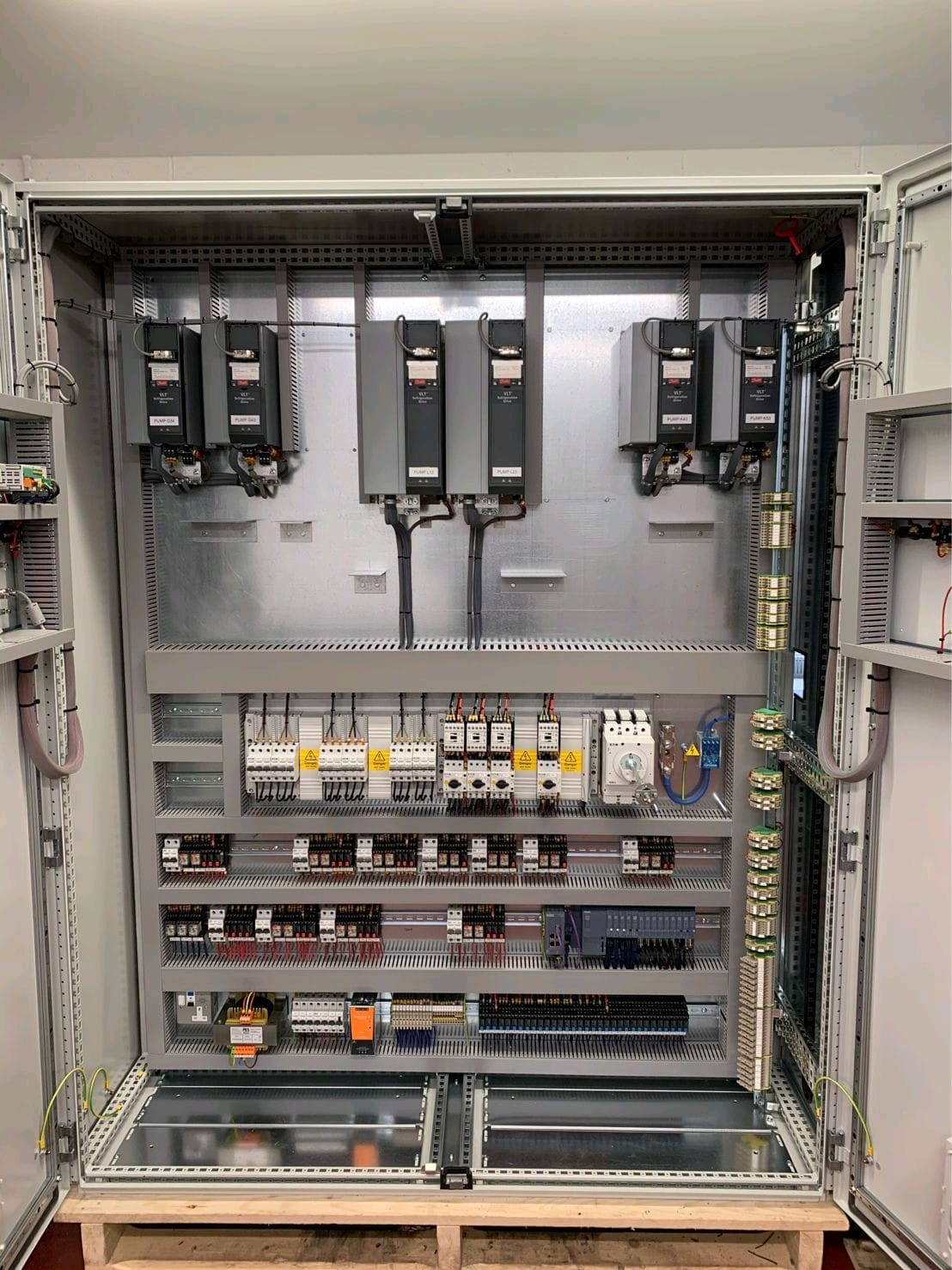
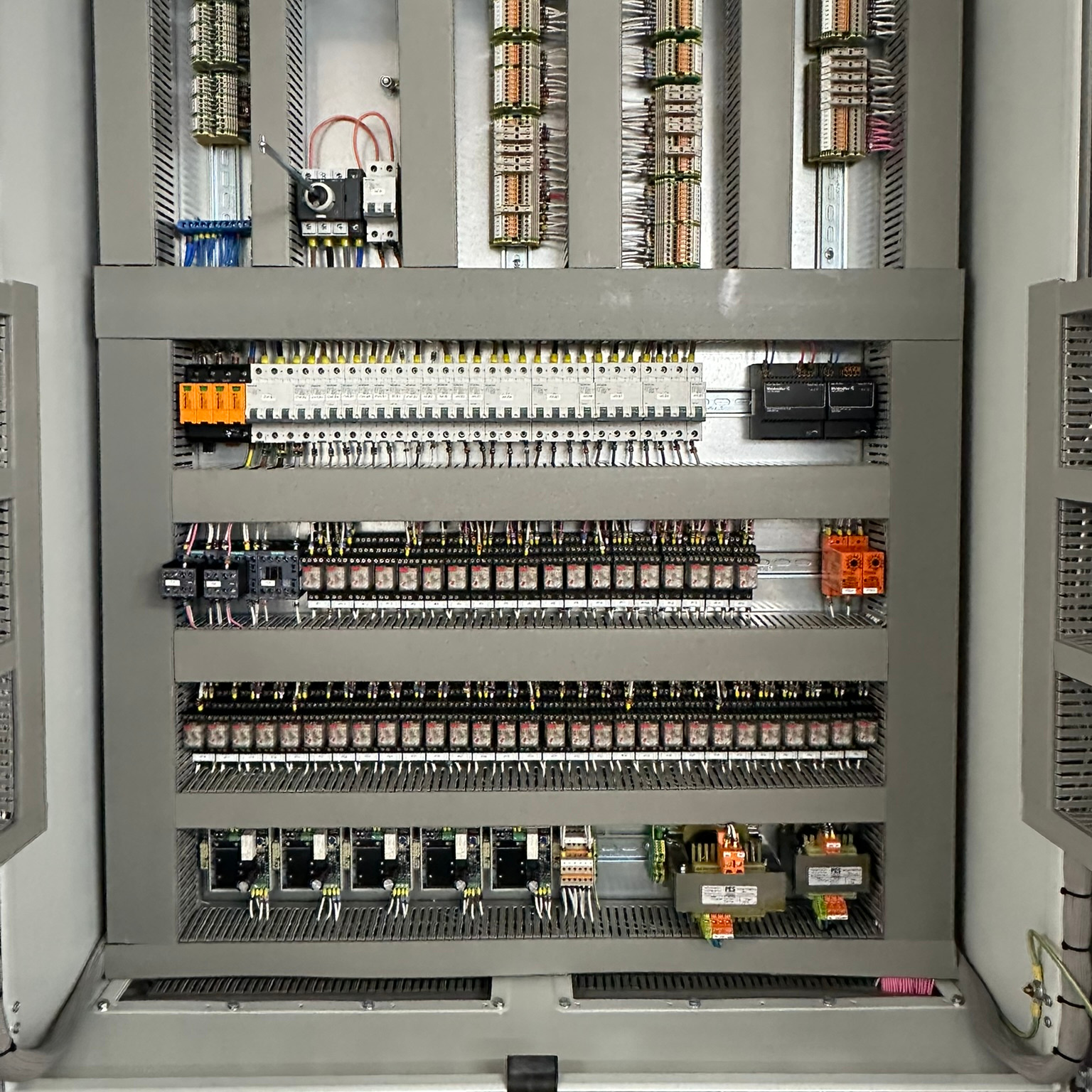
Most control panel installation tenders are primarily evaluated on day-rate pricing and availability. That approach consistently produces the wrong outcome.
Selecting electrical control panel installers for an industrial facility is a decision with a long tail. The contractor who installs your panel today creates the documentation your maintenance team relies on in three years, the compliance evidence your insurer requests after an incident, and the commissioning baseline your automation engineers depend on for every future modification.
This guide gives operations directors and procurement managers a structured evaluation framework - one that goes beyond price and reveals whether a contractor is genuinely qualified to work on industrial control infrastructure.
Why Contractor Selection Matters More Than the Tender Price
The instinctive response to a control panel installation tender is to rank contractors by price and award to the lowest credible quote. The logic is understandable, but it misprices the actual risk.
The installation cost is a one-time figure. The cost of an inadequate installation compounds over the facility's lifetime through unplanned downtime, repeat compliance work, emergency call-outs, and insurance complications. A contractor who cannot produce a full set of as-installed drawings at handover does not reduce your project cost - they transfer a hidden liability onto your operations budget.
The other factor that the tender price conceals is capability. General electrical contractors can wire a distribution board competently. Integrating a control panel into an industrial automation environment - connecting it correctly to PLC modules, SCADA systems, safety interlocks, and process instrumentation - requires a different class of competency entirely. Price alone does not distinguish between these two categories of contractor.
The real selection question
The question is not 'which contractor is cheapest?' - it is 'which contractor can deliver a compliant, documented, reliable, and future-proof installation that does not create a liability the moment the engineers leave site?'
Certifications and Accreditations That Credible Panel Installers Must Hold
Accreditation is not a differentiator in industrial panel installation - it is a baseline requirement. A contractor without the right credentials should be removed from the tender list before price is ever discussed.
The minimum accreditations to require are as follows:
NICEIC approval - NICEIC-approved contractor status confirms that the contractor's work is assessed against BS 7671 requirements. Its absence is a disqualifier. It does not, on its own, confirm industrial competency.
BS 7671 compliance evidence - Compliance must be evidenced through formal Electrical Installation Certificates, not verbal assurances. Any contractor who cannot confirm this as a standard deliverable should be disqualified.
BS EN 60204-1 competency - This standard governs the safety of machinery electrical equipment. A panel installer working in manufacturing must understand and apply its requirements to protection schemes, earthing arrangements, and safety circuit design.
Sector-relevant experience - For food processing, pharmaceutical, or high-care manufacturing environments, ask specifically whether the contractor has worked under the regulatory frameworks relevant to your sector.
Each credential maps to a specific risk. NICEIC approval addresses the risk of non-compliant wiring. BS EN 60204-1 competency addresses machinery safety. Sector experience addresses the risk of an engineer working in your environment without understanding its consequences.
Accreditation alone is not sufficient
A contractor can hold all of the above credentials and still lack the automation competency to integrate a panel into a live production environment. Credentials establish a baseline. They do not confirm specialist capability.
Why Automation and PLC Experience Sets Specialist Installers Apart
The gap between a general electrical contractor and a specialist industrial panel installer is most visible at the automation interface. This is where installations succeed or fail in production environments.
PLC integration and SCADA connectivity require programming competency that general electrical contractors do not possess. Correctly terminating field cables is one task. Verifying that I/O signals are mapped correctly, that safety interlocks are functioning as designed, and that the control logic communicates accurately with the SCADA layer is an entirely different discipline.
Ask specifically which PLC platforms the contractor works with. Siemens, Allen-Bradley, and RDM platforms each have distinct programming environments, commissioning protocols, and fault-diagnostic approaches. A contractor who has only worked on one platform - or who cannot name any platform at all - does not have the breadth of experience an industrial facility requires.
The same applies to SCADA integration. Connecting a control panel to a supervisory system involves configuration of communications protocols, alarm management, and data logging — not just physical wiring. A contractor without this competency will complete the physical installation and leave your automation engineers to resolve the integration, often at significant additional cost and delay. Relevant JBB service: PLC Programming & Automation Software Development — multi-platform PLC and SCADA integration across Siemens, Allen-Bradley, and RDM environments.
Test the automation claim
Ask the contractor to describe their commissioning process for a PLC-controlled panel. A credible specialist will immediately reference I/O verification, interlocks testing, and SCADA signal confirmation. A general contractor will describe cable termination and power-on checks. The depth and specificity of that answer is a reliable indicator of the contractor's true technical capability — vague or hardware-only responses signal limited exposure to control system integration, while fluency in I/O mapping, interlock logic, and signal validation signals genuine PLC and SCADA competence.
How to Assess Documentation Quality Before You Award the Contract
Most documentation failures are predictable. The contractor who cannot produce examples of their standard handover package during tender is the contractor who will not produce adequate documentation at project close.
Request a sample handover documentation package as part of the tender process. The package should include as a minimum:
Minimum handover documentation standard
As-installed drawings that reflect the actual installed configuration, not the original design intent
Electrical Installation Certificate issued under BS 7671 by a qualified person
Factory Acceptance Test (FAT) records completed before site delivery
Commissioning protocol records confirming site verification of all circuits and safety functions
Operation and maintenance manuals covering all installed components
Configuration backups for any PLC or SCADA elements within scope
These are not optional deliverables. As-installed drawings and testing certificates directly affect your insurance position - an insurer investigating an incident will ask for installation documentation, and an absence of formal records creates a gap in your liability defence. Maintenance engineers working on undocumented systems face extended fault-finding times and a higher risk of misdiagnosis.
Pay particular attention to how the contractor describes their as-installed drawing process. Drawings that are not updated to reflect site modifications during commissioning are not as-installed drawings - they are design documents, and they carry significant risk when used as a maintenance reference years later.
Red Flags That Should End a Contractor Evaluation Immediately
Some indicators of contractor inadequacy are subtle. Others are categorical disqualifiers. The following should end an evaluation the moment they are identified.
No Factory Acceptance Testing process - FAT must be completed before site delivery. A contractor without a FAT process introduces unquantified commissioning risk. Faults discovered on-site during live production conditions are substantially more disruptive and expensive to resolve than those found in a controlled factory environment.
No commissioning protocol - Commissioning is not power-on and walk-away. It is a systematic verification of every circuit, safety function, and automation interface. A contractor who cannot describe their commissioning protocol has no structured process for confirming the installation is safe and functional.
No post-installation support commitment - Absence of a defined support commitment creates operational dependency on a contractor who has no contractual obligation to respond. When a fault occurs at 02:00 on a Monday morning, a contractor without a support agreement has no obligation to assist.
Verbal assurances substituted for documentation - Any contractor who asserts compliance verbally without being able to reference the certification or testing record behind it is not operating to the standard industrial facilities require.
Inability to name the lead engineer - Engineer continuity matters. The person who commissions the installation carries knowledge about how decisions were made, where deviations from design occurred, and what to check first when a fault arises. A contractor who cannot commit to named engineer continuity is introducing a knowledge-continuity risk.
Illustrative scenario - representative of the engineering pattern, not a documented JBB project
Consider a food manufacturing facility where a control panel was installed by a general electrical contractor awarded on lowest price. At commissioning, no FAT records existed. The as-installed drawings were the original design schematics with handwritten notes. Eighteen months later, during a planned modification, the maintenance team identified that three I/O channels had been wired differently from the design, without documentation. Identifying and correcting the discrepancy required an emergency re-termination exercise and a new Electrical Installation Certificate - at a cost substantially exceeding the original saving on the contract award.
The Long-Term Cost Difference Between Cheap and Properly Engineered Installations
A lowest-price installation without documented maintenance provisions typically produces a higher lifecycle cost. This is not a theoretical argument - it follows directly from the absence of specific engineering deliverables.
The cost consequences compound in three areas:
Unplanned downtime - Without accurate as-installed documentation and configuration backups, fault resolution takes longer. Engineers must trace circuits manually rather than referencing drawings. PLC faults without configuration backups can extend recovery time from hours to days.
Emergency procurement - A contractor who has not maintained a strategic spares recommendation leaves the facility exposed to long lead times on failed components. Emergency procurement of obsolete or specialist parts from distribution carries significant cost premiums.
Repeat compliance work - Facilities with inadequate installation documentation face repeat compliance expenditure. EICR assessments against undocumented installations take longer, cost more, and frequently generate remedial action requirements that a properly documented installation would not have created.
A properly engineered installation from a specialist NICEIC-approved contractor - one that delivers full FAT records, as-installed drawings, and a structured commissioning protocol - is predictable to maintain, straightforward to modify, and defensible under audit. The upfront cost difference is recovered through reduced maintenance burden across the installation's operational life.
The documentation dividend
Facilities that hold accurate as-installed drawings, testing certificates, and PLC configuration backups consistently achieve faster fault resolution, lower compliance costs, and stronger insurance positions than those maintaining undocumented installations. The documentation is not an administrative overhead - it is an operational asset.
Questions to Ask During Tender That Reveal True Contractor Capability
Tender evaluation should go substantially further than day-rate pricing. The questions below are designed to reveal capability, process maturity, and whether the contractor's working practices match the demands of industrial control panel installation.
"Describe your Factory Acceptance Testing process." A credible answer will reference the test schedule, the test equipment used, the sign-off documentation produced, and the process for recording and resolving failures before dispatch.
"What does your handover documentation package include as standard?" The answer must include as-installed drawings, EIC, FAT records, commissioning records, and O&M manuals without prompting. If the contractor needs to be told what documentation is required, that is a red flag.
"Which PLC platforms do your engineers hold active competency on?" Look for named platform experience - Siemens, Allen-Bradley, RDM. Ask when they last delivered a project on each platform.
"Who will be the lead engineer on this project, and will they be present at commissioning?" Named engineer continuity from design through commissioning eliminates knowledge-transfer gaps.
"What is your post-installation support arrangement?" A contractor with a structured support offering - scheduled inspections, emergency response protocols, and maintenance contracts - is operating as a long-term partner. A contractor who cannot describe any support arrangement is a one-time installer.
"Can you provide references from comparable industrial sites?" Food processing, pharmaceutical, and manufacturing references specifically. A contractor with only commercial building experience has not been tested against the demands of industrial production environments.
Add questions specific to your site's automation architecture. If your facility runs Siemens S7 PLCs and a third-party SCADA system, ask the contractor to describe their commissioning process for that specific configuration. The quality of the answer separates genuine specialists from contractors who claim automation capability without the evidence to support it.
The JBB Electrical Control Panel Installation Methodology
Assess
JBB engineers conduct a detailed site and system review covering load calculations, BS EN 60204-1 protection requirements, PLC platform compatibility, and SCADA integration scope before a single drawing is raised - ensuring the installation design reflects actual operational requirements, not assumed ones.
Modernise
Using EPLAN Electric P8 for schematic design and in-house manufacturing capability for panel build, JBB delivers control panels manufactured to exact specification - with component selections verified against BS 7671 requirements and provisions built in for future expansion or regulatory updates.
Protect
Factory Acceptance Testing is completed at our facility before site delivery, with every I/O channel, safety interlock, and protection circuit verified against the design schematic - so commissioning at site begins from a confirmed baseline, not a starting point for fault-finding.
Prevent
Commissioning protocols verify all field terminations, PLC configuration, SCADA signal mapping, and safety system function on-site before handover - with as-installed drawings and Electrical Installation Certificates issued as standard, supporting ongoing compliance and audit readiness.
Support
As an NICEIC-approved contractor operating since 1966, JBB provides structured post-installation support through scheduled maintenance, emergency response, and a critical spares strategy - ensuring that the same team that designed, built, and commissioned your panel remains available when you need them.
The same team carries knowledge from design through commissioning and into ongoing maintenance - eliminating the accountability gaps that arise when design, manufacture, and installation are divided between different contractors.
Next Step: Request a Compliance & Breakdown Prevention Assessment
A Compliance & Breakdown Prevention Assessment identifies the electrical, compliance, and breakdown risks affecting your operation, and sets out the engineering actions needed to reduce downtime, protect reliability, and keep your infrastructure defensibly compliant. Request a Compliance & Breakdown Prevention Assessment today to verify that your current or planned control panel installation meets the documentation, certification, and commissioning standards your facility and insurer require.
Compliance & Breakdown Prevention Assessment