In food manufacturing and temperature-critical environments, food safety compliance is not achieved through documentation alone. It is achieved through control. Every critical process parameter – temperature, time, sequencing, sanitation, and segregation – must be maintained within defined limits, consistently and verifiably, under real operating conditions. Food safety management is now a comprehensive, technology-driven system that integrates automation and digital tools to enhance food safety protocols and ensure robust compliance.
As production volumes increase and regulatory scrutiny intensifies, the food industry is being transformed by automation to meet evolving regulatory standards. Manual controls and paper-based systems struggle to keep pace. Human intervention introduces variability at precisely the points where consistency and traceability are required. This is where automation becomes fundamental to modern food safety compliance.
This article explains how automation enhances food safety compliance in industrial food environments, the risks created by manual and semi-automated systems, the engineering and regulatory considerations involved, and how PLC and SCADA systems improve reliability, uptime, and audit readiness. Meeting regulatory standards is essential, and automation is shaping the future of food safety compliance by enabling real-time monitoring and rapid response to potential issues.
💡 Key Insight: Most food safety failures do not begin with contamination. They begin with loss of control, loss of visibility, or delayed response.
Why Food Safety Compliance Is Increasingly System-Dependent
Modern food safety frameworks such as HACCP, BRCGS, SALSA, and ISO 22000 are built on the principle of controlled processes. They require food producers to identify critical control points, define acceptable limits, monitor those limits, and retain evidence that control was maintained.
In contemporary food manufacturing, these requirements extend beyond simple checks. Facilities operate with high-throughput production lines, integrated refrigeration systems, complex changeovers, and multiple product variants. Food businesses and food companies face increasing complexity in their operations, making it essential to leverage automation to improve efficiency in meeting compliance demands. Maintaining compliance manually across these environments is increasingly impractical.
Automation provides the infrastructure required to manage this complexity. Companies benefit from automation by streamlining compliance efforts and improving operational efficiency. It replaces reliance on memory, availability, and interpretation with engineered systems that apply controls consistently and record outcomes automatically.
The Risks Created by Manual and Semi-Automated Controls
Many food facilities continue to rely on manual temperature checks, paper records, or partially automated systems. While these approaches may satisfy minimum expectations on paper, they introduce multiple risk points in practice, especially due to the potential for human error in manual processes.
Manual systems depend on people performing tasks at the correct time, in the correct way, every time. In high-pressure production environments, this assumption rarely holds consistently. Maintaining accurate records is challenging with manual methods, making it difficult to ensure compliance with food safety regulations and industry standards.
⚠ Warning: If food safety depends on people remembering to record data, compliance is already fragile.
Common Failure Modes in Manual Systems
Missed temperature checks during busy periods
Delayed response to refrigeration or process faults
Illegible, incomplete, or back-filled records
No real-time visibility of deviation
Inconsistent application of procedures across shifts
These failures can result in quality issues and increase the risk of substandard products reaching consumers.
Each of these failure modes weakens compliance, even when intentions are good. Automation reduces exposure by removing reliance on human memory and judgement for routine control tasks.
What Automation Means in a Food Safety Context
Automation in food safety is not limited to robotics or high-speed processing equipment. It refers to the use of control systems, sensors, and software to monitor, enforce, and document critical conditions automatically. In modern food safety management, automation technologies, digital tools, and food safety software are increasingly used to streamline compliance, enable real-time monitoring, and facilitate audit readiness.
📘 Definition: Food safety automation is the use of PLC, SCADA, and monitoring systems to maintain critical process parameters within defined limits and generate continuous, auditable evidence of compliance.
This includes temperature monitoring, process sequencing, interlocking, alarm management, data logging, and controlled user access. Quality control systems, often integrated with automation, leverage sensors, AI, and IoT technologies to ensure consistent safety and regulatory compliance throughout the production process. Properly engineered, these systems ensure that food safety controls are applied consistently, regardless of staffing levels or production pressure.
Machine learning, artificial intelligence, and automation of machine learning applications are transforming food safety automation. AI and machine learning can identify anomalies in food production processes that might be missed by human inspection, and machine learning models can predict food safety risks before they appear by analysing historical data and real-time inputs. AI-driven traceability systems provide granular insights that facility managers can use to make improvements in food safety. By enhancing the capabilities of automated systems, AI and machine learning enable advanced pattern recognition, flagging of issues, and optimisation of food production processes in ways previously unfeasible.
How Automation Directly Enhances Food Safety Compliance
Automation enhances compliance by embedding control into the process itself. Rather than relying on checks after the fact, automated systems prevent unsafe conditions from occurring or persisting. Automation technologies reinforce food safety practices by revamping sanitation and quality control processes, ensuring that both safety and quality are maintained at every stage.
Once configured, automated systems do not forget, rush, or bypass procedures. They enforce compliance by design. Automated systems help detect contaminants, remove substandard products, and reduce contamination incidents, ensuring product quality and adherence to quality standards. Automation enables rapid corrective action when deviations are detected, minimising risks and maintaining compliance. Food quality control is strengthened through these technologies, highlighting the importance of maintaining quality throughout the entire process.
Core Compliance Benefits of Automation
Consistency – Critical parameters are maintained every cycle
Visibility – Real-time monitoring of control points
Speed – Immediate detection and escalation of deviation
Traceability – Automatic creation of audit-ready records
Prevention – Interlocks prevent unsafe operation
Automation improves operational efficiency, helps reduce waste, and minimises waste in food safety processes. It also helps optimise team output by eliminating repetitive tasks, allowing staff to focus on proactive food safety strategies.
These capabilities align directly with HACCP principles and auditor expectations.
Temperature Control as a Critical Automation Use Case
Temperature control is one of the most critical factors in food safety. Whether managing chilling, freezing, cooking, or storage, deviation outside defined limits can compromise product safety, shelf life, and regulatory compliance. For fresh produce and baked goods, maintaining precise temperature is essential to preserve quality and prevent spoilage. Food manufacturers rely on automation to ensure consistent temperature control and meet stringent safety standards.
Manual temperature checks provide only snapshots in time. They cannot detect rapid changes, overnight failures, or transient faults. Automation replaces these gaps with continuous monitoring.
🔧 Example: A PLC-controlled cold store continuously monitors air and product temperatures. If a refrigeration fault occurs overnight, alarms alert engineers immediately, preventing prolonged temperature excursions. Automated systems can also help detect foreign objects in temperature-critical environments, further enhancing food safety compliance.
Automation Advantages in Temperature-Critical Systems
Continuous monitoring instead of periodic checks
Automatic alarm escalation for out-of-hours events
Logged temperature data for audits and investigations
Integration with refrigeration and control systems
Reduced risk of undetected excursions
Automation also enables enhanced traceability and food traceability, facilitating accurate farm-to-fork tracking of ingredients and products using barcodes, RFID tags, and blockchain technology for rapid recalls. In the event of a recall, automated systems can generate a full traceability report in minutes, not days.
For cold storage and food processing facilities, these capabilities significantly reduce both compliance and commercial risk.
Process Control, Sequencing, and Hygiene Enforcement
Many food safety incidents arise not from individual parameter failure, but from incorrect sequencing or incomplete processes. Cleaning-in-place cycles, allergen changeovers, and sanitation routines are particularly vulnerable.
Automation ensures that processes occur in the correct order and that critical steps cannot be skipped, shortened, or bypassed under production pressure.
❗ Important: Automation does not just monitor food safety – it enforces it.
Examples of Automated Hygiene Safeguards
Interlocked CIP cycles that must complete fully
Recipe management preventing incorrect parameter selection
Automated allergen changeover verification
Blocked startup if sanitation criteria are not met
These controls reduce dependence on procedural discipline alone and significantly lower the risk of cross-contamination.
Data Logging, Traceability, and Audit Confidence
Food safety audits increasingly focus on data integrity. Auditors expect records that are complete, legible, time-stamped, and tamper-resistant. Manual logs are vulnerable to error and inconsistency.
SCADA systems automatically record process data, alarms, acknowledgements, and operator actions, creating a detailed operational history.
✅ Audit Outcome: Automated data logging significantly reduces audit preparation time and increases confidence in compliance evidence.
What Automated Records Provide
Time-stamped process values
Alarm history and response times
User access and intervention records
Trend data for investigation and improvement
This level of traceability supports both regulatory compliance and continuous improvement initiatives.
Reducing Downtime While Strengthening Compliance
There is a common perception that stricter compliance controls reduce operational flexibility. In practice, well-designed automation often improves uptime by detecting issues earlier and preventing unsafe operation. Automated logistics solutions help companies bring products to market more efficiently by modernising the collection, management, and sharing of data.
Automated systems identify faults before they escalate into product loss, forced shutdowns, or audit findings. Automation also enhances traceability across the supply chain, ensuring food safety, transparency, and regulatory compliance from farm to fork.
📊 Operational Insight: Facilities using automated monitoring experience fewer unplanned shutdowns linked to temperature and process deviation.
Engineering Considerations for Food Safety Automation
Automation only delivers compliance benefits when engineered correctly. Poorly designed systems can add complexity without improving control. Aligning automation with food safety regulations and regulatory standards is essential for achieving compliance and maintaining operational excellence. Automation can also streamline regulatory compliance by allowing for swift reconfiguration of monitoring parameters and control processes.
Engineering decisions must align with food safety risk analysis, not just operational convenience, and must also consider the importance of meeting evolving regulations in the food industry.
❌ Common Mistake: Installing automation without aligning it to HACCP plans and audit requirements.
Key Engineering Priorities
Food-grade, reliable sensors
Fail-safe control logic
Clear alarm prioritisation and escalation
Documented PLC logic and change control
Integration with maintenance and testing regimes
The Role of PLC and SCADA Systems
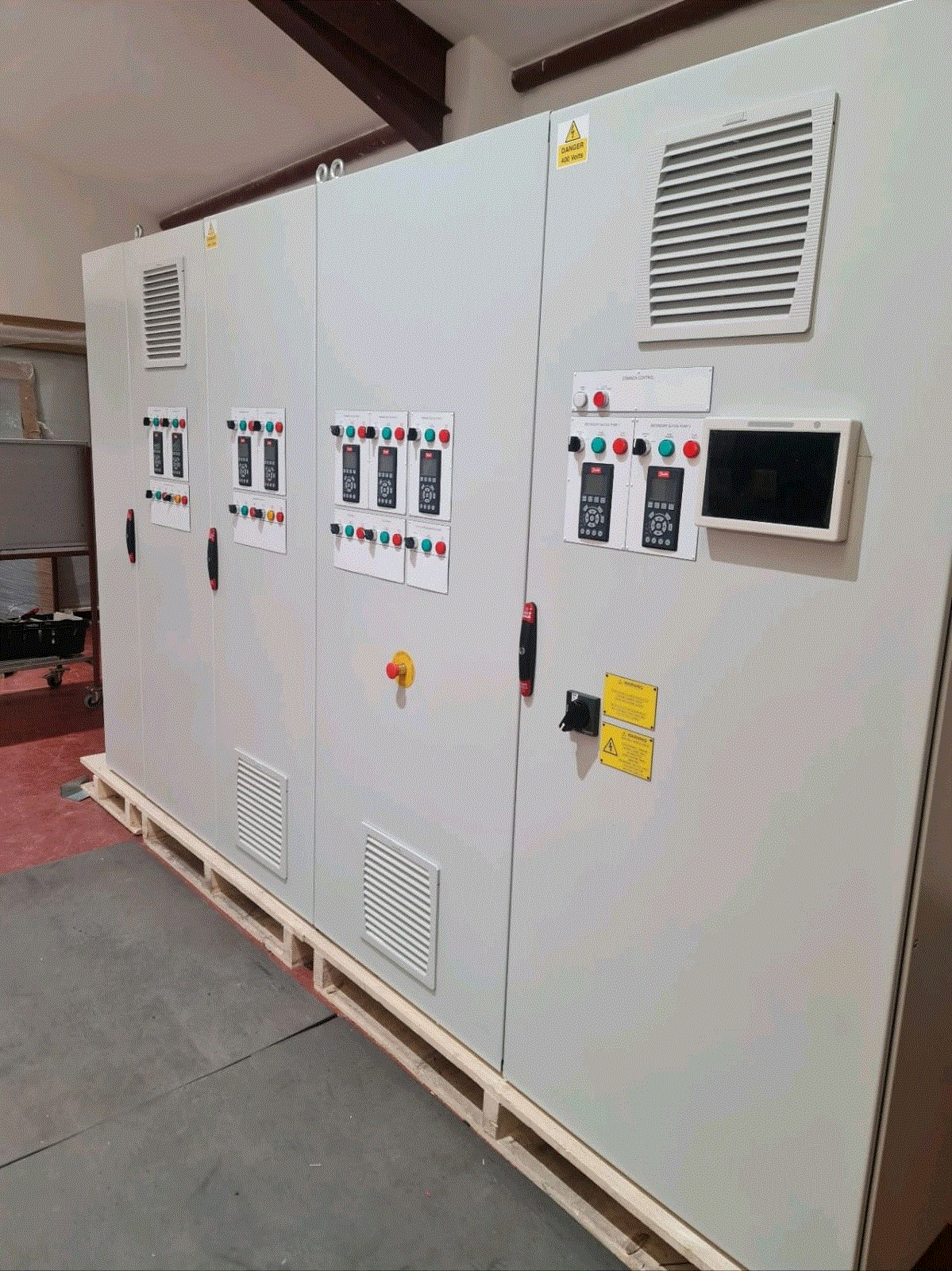
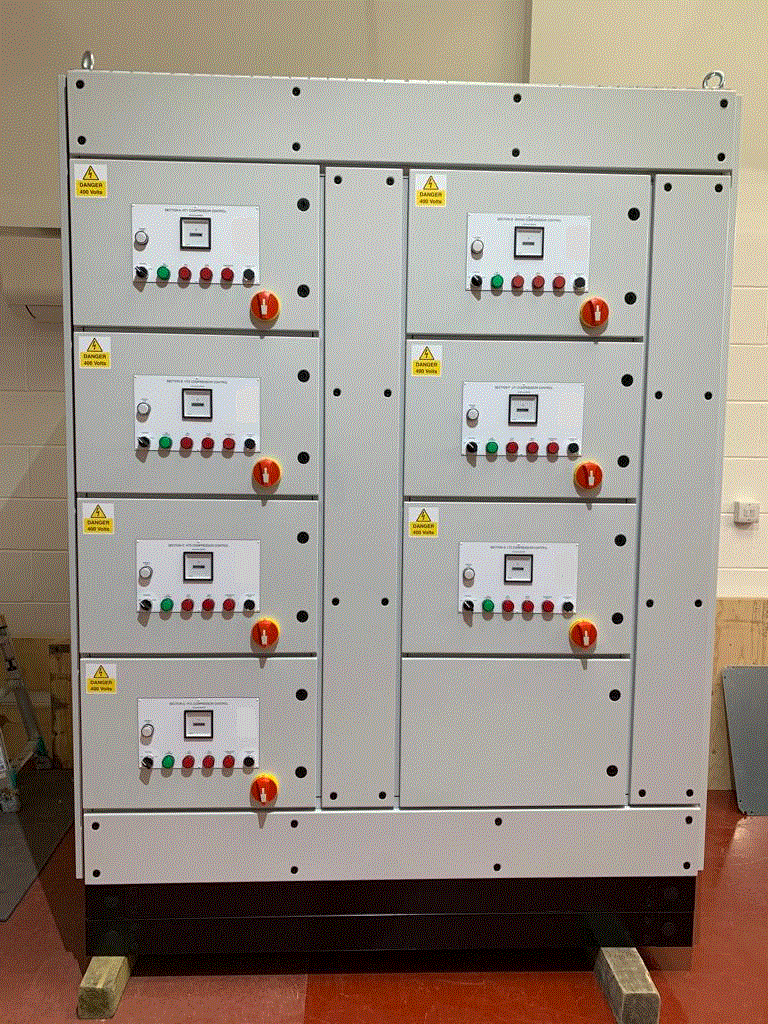
PLC and SCADA systems form the backbone of food safety automation. PLCs provide deterministic, real-time control. SCADA systems provide visibility, logging, and operator interaction. These systems help companies manage complex operations by streamlining food safety processes and automating production workflows. Automation empowers manufacturers, distributors, and retailers to swiftly identify, track, and isolate affected products during food safety issues.
Together, they create a platform where compliance is enforced, monitored, and evidenced.
PLC & SCADA Compliance Functions
Real-time control of critical processes
Automated alarm management
Secure user access and permissions
Data logging and reporting
Integration with temperature monitoring and refrigeration systems
The Importance of Preventive Maintenance in Automated Systems
Automation does not remove the need for maintenance. Sensors drift, panels age, and software environments evolve. Preventive maintenance ensures automated controls remain trustworthy.
Food safety automation assets should be treated as safety-critical systems within maintenance planning.
💡 Best Practice: Include automation assets in preventive maintenance and testing schedules.
JBB’s Approach to Food Safety Automation
JBB Electrical designs and delivers automation systems for compliance-driven, temperature-critical environments. By leveraging automation, JBB provides clients with a comprehensive food safety program that enhances compliance, streamlines audits, and reduces risks. Solutions are engineered to support food safety, uptime, and audit readiness simultaneously. Automation also helps food companies gain better visibility into operations across the supply chain, helping them identify opportunities to reduce waste and conserve resources.
Assess → Modernise → Protect → Prevent → Support
Assess – Identify food safety risks and control gaps
Modernise – Upgrade control panels, PLCs, and monitoring
Protect – Implement alarms, interlocks, and safeguards
Prevent – Maintain systems through structured maintenance
Support – Provide documentation and ongoing technical support
Frequently Asked Questions
What risks does lack of automation create?
Greater reliance on human intervention increases the likelihood of missed deviations, incomplete records, delayed response, and audit non-conformances.
How does compliance affect automation design?
Automation must align with HACCP principles, audit requirements, and traceability expectations to deliver genuine compliance benefits.
What preventive measures should food facilities prioritise?
Automated monitoring, alarm management, preventive maintenance, and documentation integrity.
How do modern systems improve reliability?
They provide continuous visibility, early fault detection, and enforce safe operation without relying on manual intervention.
Next Steps – Strengthen Food Safety Through Automation
Food safety compliance is only as strong as the systems that support it. Looking to the future, by 2026, automation will shift food safety compliance from reactive paper-based logs to proactive, real-time digital intelligence. Automation plays an essential role in achieving this future, providing the consistency, visibility, and control required to protect product, people, and reputation.
Request a Compliance & Breakdown Prevention Assessment with JBB Electrical to evaluate how automation can strengthen food safety compliance across your operation.