Refrigeration control panel failure is one of the fastest routes from a routine electrical fault to a full cold storage shutdown — and the financial exposure it creates. A single fault inside a refrigeration control panel rarely announces itself with warning. A relay fails silently. A contactor overheats and drops out. A control board fault kills the signal to your compressor. Within hours, you are no longer managing an electrical problem — you are managing a product loss event, a regulatory exposure, and an insurance claim.
Operations directors at cold storage and food processing facilities face a specific risk that is easy to underestimate: the speed at which one panel component failure cascades into a full cold storage shutdown. This article maps that cascade, quantifies the exposure, and sets out the proactive engineering decisions that eliminate the risk before it reaches product.
How One Control Panel Fault Cascades Into a Full Cold Storage Shutdown
The failure sequence is well understood by engineers who work with refrigeration control systems. What is less understood at a strategic level is how quickly it moves - and how little margin there is once it starts.
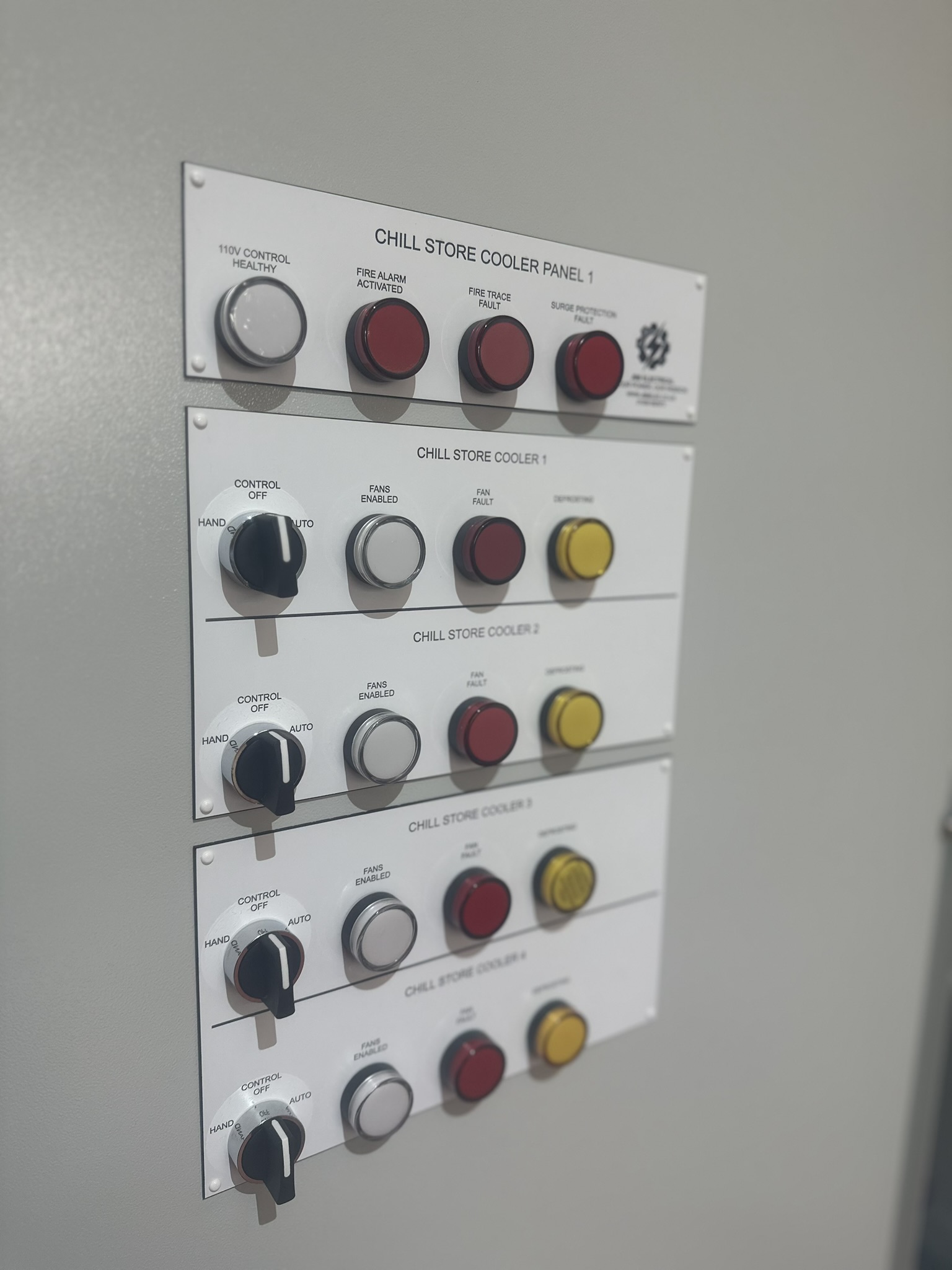
A refrigeration control panel is the nerve centre of your cold store. It manages compressor sequencing, condenser fan operation, defrost cycles, alarm triggering, and safety interlocks. Every one of those functions depends on a chain of components - contactors, protection relays, control boards, terminal connections - each carrying its share of operational load.
When one link in that chain fails, the consequences do not stay contained. A contactor burnout stops the compressor. A protection relay fault prevents a restart. A failing control board can take the entire panel offline. Depending on your system's redundancy - or lack of it - a single component can be the difference between a brief interruption and a complete loss of refrigeration.
The Hours That Matter Most
Once compressor shutdown occurs, temperature in a loaded cold store rises at a rate determined by insulation quality, ambient conditions, and product density. For many food categories, the safe storage threshold is breached within a matter of hours - not days. The engineering clock starts the moment the panel goes offline.
The cascade has a predictable sequence. Compressor shutdown eliminates active cooling. Temperature begins to rise. Alarms trigger - assuming monitoring systems are functional and independent of the faulted panel. By the time a maintenance response is mobilised, sourced a fault diagnosis, and begun emergency procurement, the temperature breach is no longer a risk. It is a fact.
The Real Financial Exposure: Product Loss, Regulatory Penalties, and Insurance Implications
The cost of a refrigeration control panel failure is not the cost of the failed component. It is the layered financial exposure that accumulates during the hours and days the system is offline.
- Product spoilage: temperature-sensitive stock that breaches safe storage thresholds becomes unsaleable or - in regulated environments - legally non-compliant. The financial impact scales directly with store capacity and product value.
- Regulatory exposure: food safety legislation requires that temperature excursions are documented, investigated, and rectified. Where maintenance records are absent or inadequate, the regulatory position deteriorates rapidly. Prosecution risk and formal improvement notices are live outcomes.
- Insurance complications: insurers scrutinise maintenance records following a cold chain failure claim. Where no documented maintenance programme exists - no inspection records, no test certificates, no thermal imaging history - a legitimate claim can be disputed or reduced. That is a direct financial consequence of deferred maintenance.
- Extended downtime costs: cold storage capacity lost during repair and product restocking represents operational disruption that extends well beyond the immediate incident. Customer commitments, production schedules, and logistics chains are all affected.
Audit Trail Is Not Optional
Comprehensive maintenance documentation - inspection records, BS 7671 test certificates, thermal imaging reports, and protection test results - forms the audit trail that protects your facility during food safety inspections and insurance investigations. Without it, your engineering team's response to the failure is the only evidence available. That is rarely sufficient.
Why Reactive Repair Is the Most Expensive Decision You Can Make
Reactive repair feels like a rational response to an unexpected failure. It is not. For refrigeration control infrastructure, reactive repair is a cost model that consistently exceeds the investment a proactive programme would have required.
The problem is procurement lead time. Specialist refrigeration panel components - particularly for older or bespoke systems - are not available from a distributor shelf. A custom contactor assembly, a proprietary control board, or a specific protection relay configured for your system may carry a procurement lead time measured in days. During that time, your cold store is offline and your product is at risk.
Emergency call-out rates compound the cost. Reactive response involves premium labour rates, urgent freight charges, and - if the fault occurs out of hours - overtime premiums that a planned maintenance programme would never incur. The total cost of a reactive repair event, inclusive of product loss and downtime, consistently dwarfs the cost of the component that failed.
Illustrative Scenario: Contactor Failure in a Cold Store Panel
Consider a food distribution cold store where a main compressor contactor fails during a weekend night shift. The panel is a bespoke assembly from a manufacturer no longer supplying the UK market. Emergency procurement identifies the correct specification replacement with a four-day delivery lead time. Over that period, the cold store operates at reduced capacity using a secondary system, product in the affected zone must be relocated or written off, and a food safety visit is triggered by the temperature excursion records. A site-specific critical spares inventory holding this component would have reduced total downtime to under four hours. Illustrative example based on representative JBB project work.
How a Strategic Critical Spares Programme Eliminates Extended Downtime
The core principle of a critical spares programme for refrigeration control infrastructure is straightforward: identify every component whose failure would cause extended downtime, then hold that component on site — or in a managed inventory — with a verified replacement procedure ready to deploy. JBB Electrical's Critical Spares Strategy & Component Supply service is built around exactly this discipline.
The process begins with a single-point-of-failure analysis across your refrigeration panel estate — identifying contactors, protection relays, control boards, fuses, and other components where there is no redundancy and no fast-procurement alternative. Each identified component is assessed for its lead time risk and its consequence of failure.
- Single-point-of-failure mapping across all refrigeration control panels, including assessment of bespoke or obsolete components.
- Site-specific inventory of critical components, held either on site or in a managed off-site store with agreed response times.
- Installation procedures and commissioning checklists for each spared component, so that replacement can be completed by your maintenance team or a JBB engineer without delay.
- Configuration backups for any programmable components - control boards, PLCs, HMI screens - ensuring correct restoration without specialist re-commissioning time.
- Obsolescence monitoring for end-of-life components, with proactive replacement scheduling before manufacturer support expires.
The operational outcome is concrete: when a component fails, the replacement is available on site, the procedure is documented, and the configuration is backed up. Recovery is measured in hours, not days. The cold store is back online before the temperature breach becomes a product loss event.
Obsolescence Is a Silent Risk
Refrigeration control panels installed ten or more years ago frequently contain components that are discontinued or approaching end-of-life. When those components fail, emergency procurement becomes impossible rather than simply expensive. A proactive obsolescence review - part of any rigorous critical spares strategy - identifies these risks while replacement options still exist.
What Proactive Maintenance Catches Before Panel Failure Occurs
Most refrigeration control panel failures do not arrive without warning. The warning is simply not being looked for.
Thermal imaging surveys are the most effective single tool for identifying deteriorating components before they fail. By measuring the temperature signature of live panel components - contactors, busbars, terminal connections, protection devices - a thermal imaging inspection identifies overheating that indicates increased resistance, partial failure, or overloading. A contactor running significantly above its reference temperature is a compressor shutdown waiting to happen. Identified under a scheduled inspection, it is a planned replacement during a maintenance window. Left undetected, it is an emergency.
Protection testing complements thermal imaging by verifying that the panel's safety systems will operate correctly under fault conditions. Refrigeration control panels must meet the requirements of both BS 7671 and BS EN 60204-1, which sets out the safety of machinery electrical equipment — including protection relay settings, safety interlock design, and fault detection performance. A protection relay that has drifted out of calibration, or a safety interlock that has been bypassed and not reinstated, will not prevent a cascading failure — it will allow one. Regular protection testing, carried out as part of a structured maintenance programme and documented to these standards, confirms that your panel's defences are functional.
- Thermal imaging: identifies overheating contactors, failing connections, and overloaded circuits weeks before they cause panel shutdown.
- Protection testing: verifies that safety interlocks, protection relays, and fault detection systems will operate correctly when needed.
- Power quality analysis: identifies voltage imbalance or harmonic distortion that accelerates component deterioration in refrigeration control systems.
- Visual inspection and torque verification: loose connections are a primary cause of contact degradation in panels subjected to regular thermal cycling.
- BS 7671 compliance audit: confirms the panel remains compliant with current wiring regulations, protecting the facility's legal and insurance position.
Building a Failure-Prevention Strategy for Refrigeration Control Infrastructure
Preventing refrigeration control panel failure is not a single intervention. It is an engineered strategy that spans panel design, ongoing maintenance, and spares management - each element reinforcing the others.
At the design level, panels built with future expansion and component obsolescence in mind carry a lower long-term failure risk. JBB Electrical's Control Panels and MCC Design capability builds refrigeration control panels using component selections that are current, supportable, and specified for the thermal and operational demands of cold storage environments. Documentation - schematics, test certificates, commissioning records - is delivered as standard, forming the baseline of the maintenance audit trail.
For existing panel estates, the Refrigeration Control Systems service and Preventive Electrical Maintenance programmes work together. The maintenance programme identifies deterioration early. The critical spares strategy ensures that identified risks are backed by fast-response inventory. Temperature Monitoring integration adds a further layer — real-time alerting that confirms system performance and flags anomalies before they become failures.
The JBB Refrigeration Control Panel Methodology
The JBB Refrigeration Control Panel Methodology
Assess
As a NICEIC-approved contractor, JBB Electrical conducts a full panel audit covering thermal imaging of contactors and connections, BS 7671 compliance verification, protection relay calibration checks, and single-point-of-failure mapping across the refrigeration control estate - producing a prioritised risk register specific to your cold storage infrastructure.
Modernise
Where panels contain obsolete contactors, end-of-life control boards, or bespoke components with no available replacement, JBB Electrical's in-house manufacturing capability enables targeted refurbishment or full panel replacement - designed using EPLAN Electric P8 and built to current regulatory standards with provisions for future expansion.
Protect
Protection testing verifies that every safety interlock, fault detection relay, and compressor protection device within the refrigeration panel will operate correctly under fault conditions - eliminating the cascading failure risk that occurs when protection systems have drifted or been inadvertently bypassed.
Prevent
A site-specific critical spares inventory is established for every identified single point of failure in the refrigeration control panel - contactors, protection relays, control boards, and programmable components - with installation procedures, commissioning checklists, and configuration backups ready for immediate deployment.
Support
JBB Electrical provides ongoing scheduled inspections, thermal imaging surveys, and immediate response protocols under a structured maintenance contract - with the same team that designed, built, tested, and documented the system, eliminating the accountability gaps that arise when design, manufacture, and installation are divided between different contractors.
This structured approach transforms refrigeration control infrastructure from a reactive cost centre into a managed, predictable asset. Founded 1966, JBB Electrical brings decades of hands-on experience to cold storage and food processing environments where panel failure is not a theoretical risk - it is a live operational threat with direct financial consequences.
The Compliance & Breakdown Prevention Assessment
A Compliance & Breakdown Prevention Assessment applied to refrigeration control infrastructure identifies the specific components, documentation gaps, and maintenance regime deficiencies that create your cold storage failure risk - and produces a prioritised action plan with defined timelines, so every intervention is planned, documented, and defensible.
Next Step: Request a Compliance & Breakdown Prevention Assessment
Next Step: Request a Compliance & Breakdown Prevention Assessment
A Compliance & Breakdown Prevention Assessment identifies the electrical, compliance, and breakdown risks affecting your operation, and sets out the engineering actions needed to reduce downtime, protect reliability, and keep your infrastructure defensibly compliant. Request a Compliance & Breakdown Prevention Assessment today to protect your cold storage operation from refrigeration control panel failure and the product loss, regulatory exposure, and extended downtime that follows.
Compliance & Breakdown Prevention Assessment