Most industrial sites don’t have a monitoring problem - they have a visibility problem. Data exists in your plant, but it’s fragmented across control panels, PLCs, drives, refrigeration controllers, BMS interfaces, spreadsheets, and engineer knowledge. When something starts to drift, you find out late - often when production quality drops, alarms escalate, or a breakdown stops the line.
SCADA (Supervisory Control and Data Acquisition) changes that. Done properly, SCADA gives you real-time visibility of process performance, asset condition, alarms, and compliance evidence across your operation - especially in production-critical and temperature-critical environments like food manufacturing and cold storage. SCADA systems have evolved from early computer-based control to today's centralised platforms, which aggregate and visualise data from across the operation.
SCADA systems are the backbone of many modern industries, including manufacturing, energy, water treatment, and transportation.
This article explains how SCADA improves visibility in industrial operations, what risks poor visibility creates, how SCADA supports compliance, and what engineering decisions matter if you want reliability, uptime, and audit-ready reporting - not just “a screen with numbers”.
💡 Key Insight: SCADA is not a dashboard. It’s a risk visibility layer that turns control system signals into operational evidence - alarms, trends, reports, and actions that prevent downtime. SCADA visibility involves both real-time and historical insight into the operational network, including machinery status and process variables.
What SCADA Actually Does in an Industrial Site
SCADA sits above your PLCs and control systems. It collects data from controllers (and sometimes instruments directly), as well as from remote sensors and devices, transmitting this information to a centralised system for analysis and display. SCADA visualises live conditions, records history, manages alarms, and produces reporting that helps you prove compliance and improve performance.
📘 Definition: SCADA (Supervisory Control and Data Acquisition) is a system that supervises industrial processes by collecting data from PLCs, field devices, and remote sensors, presenting it on HMIs (human machine interfaces) that act as the visual interface for operators to monitor and manage processes. The HMI enables operators to view real-time data, log history, manage alarms, and access reporting and remote oversight.
In practical terms, SCADA improves visibility in four ways:
Operational visibility - live state of processes, lines, zones, and critical assets, with real-time monitoring and real-time data enabling operators to respond quickly to alerts and anomalies through the HMI
Risk visibility - early warning trends, abnormal conditions, and alarm patterns
Compliance visibility - traceable logs, reports, and evidence of control
Engineering visibility - quicker fault-finding, consistent diagnostics, and documented behaviour
The Risks Created by Poor Visibility
Without effective visibility, industrial operations become reactive. You rely on operator observation, local panel indicators, and “we’ll see it when it fails”. That approach increases downtime risk, extends fault-finding time, and weakens compliance evidence.
Without SCADA, reliance on manual operations increases the risk of human error, which can lead to higher labour costs and operational inefficiencies.
⚠ Visibility Risk: If you only discover problems at the point of failure, your plant is running on luck - not engineering control.
Common failure patterns caused or amplified by low visibility include:
Slow drift - motors overheating, compressor cycling, valve wear, sensor drift, or pressure instability that gradually worsens
Alarm blindness - too many alarms, no prioritisation, operators ignoring alerts
Hidden interlocks - safety or process interlocks that trip with no clear root cause visible
Unknown downtime drivers - repeated “nuisance trips” with no historical trail
Documentation gaps - you can’t prove what happened, when, or why
❌ Common Mistake: Treating SCADA as a “nice-to-have visual layer” rather than a core tool for downtime prevention, compliance evidence, and lifecycle control.
How SCADA Improves Visibility Day-to-Day
1) Real-time process state - not just local panel indicators
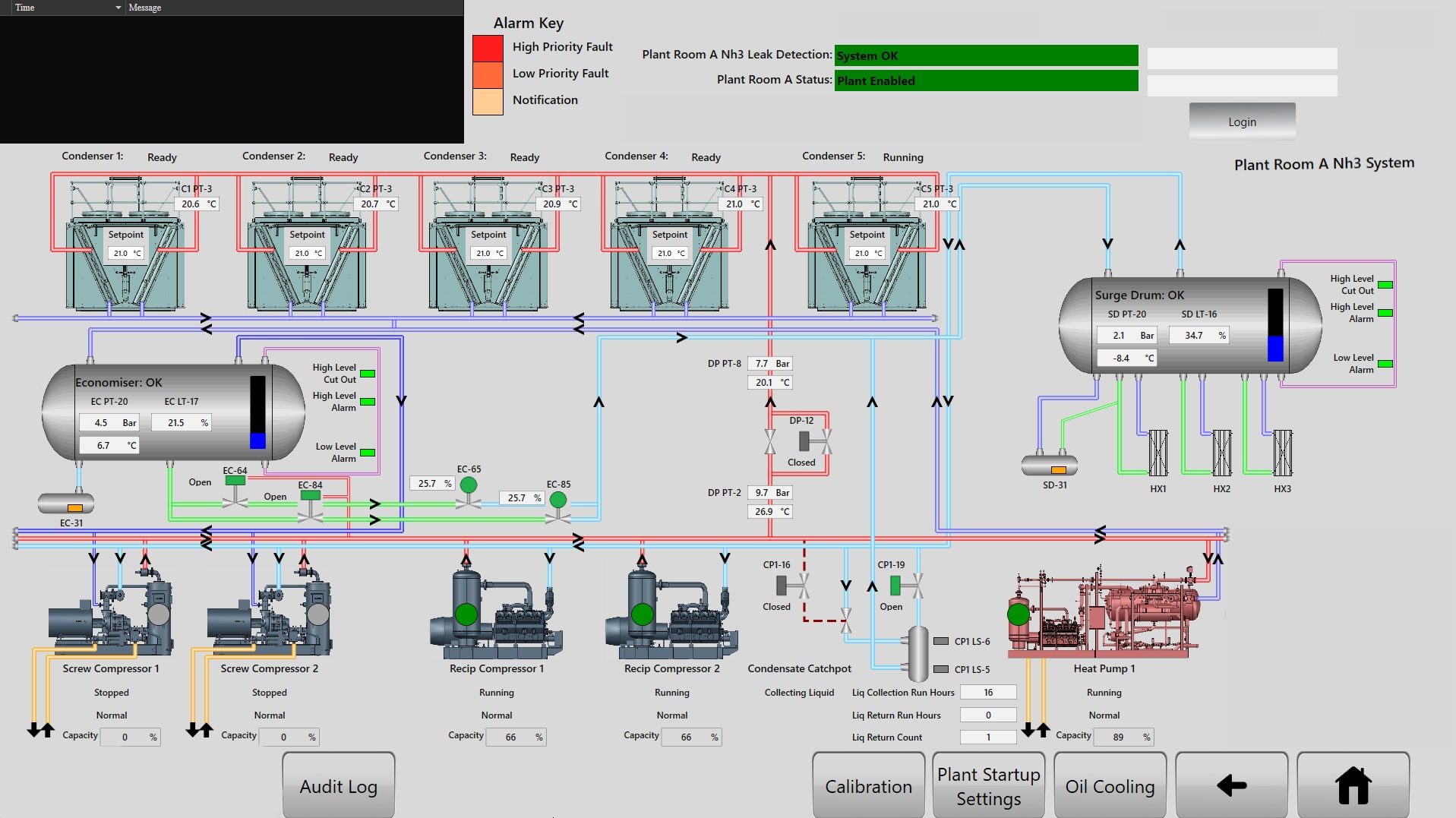
A well-designed SCADA view shows what matters: line status, mode, permissives, interlocks, critical temperatures, pressures, tank levels, energy draw, and equipment availability. SCADA systems are essential for controlling industrial processes and managing complex processes across large or multi-zone sites. It reduces reliance on local panels and manual checks, especially across large sites and multi-zone operations.
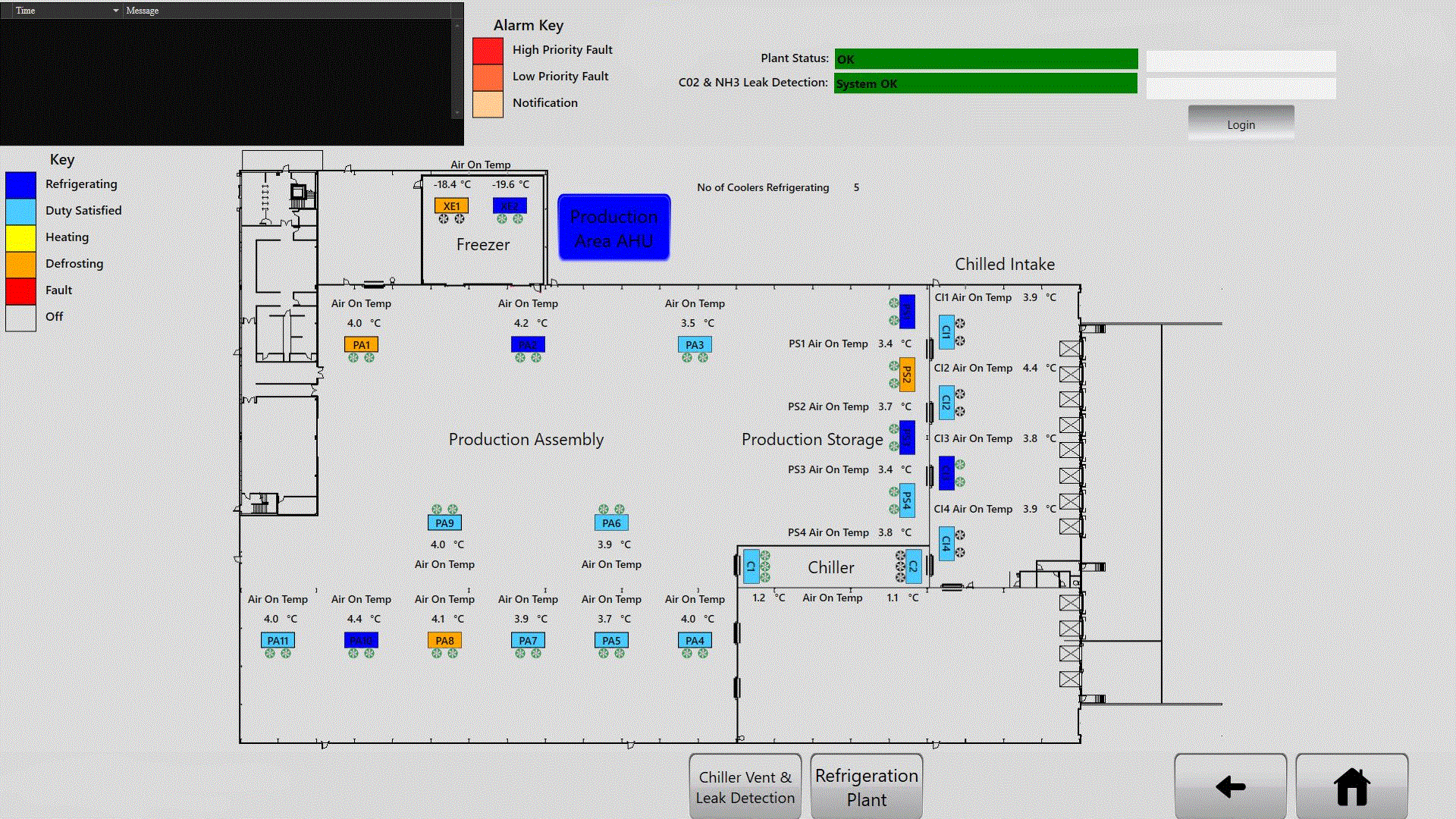
🧪 Example: In cold storage, SCADA can display each zone’s setpoint, actual temperature, defrost state, alarm status, and compressor health in one place - making excursions and instability visible before product risk escalates. Modern SCADA systems allow real-time data from the plant floor to be accessed from anywhere in the world, supporting remote oversight and rapid response.
2) Trends and history - visibility over time
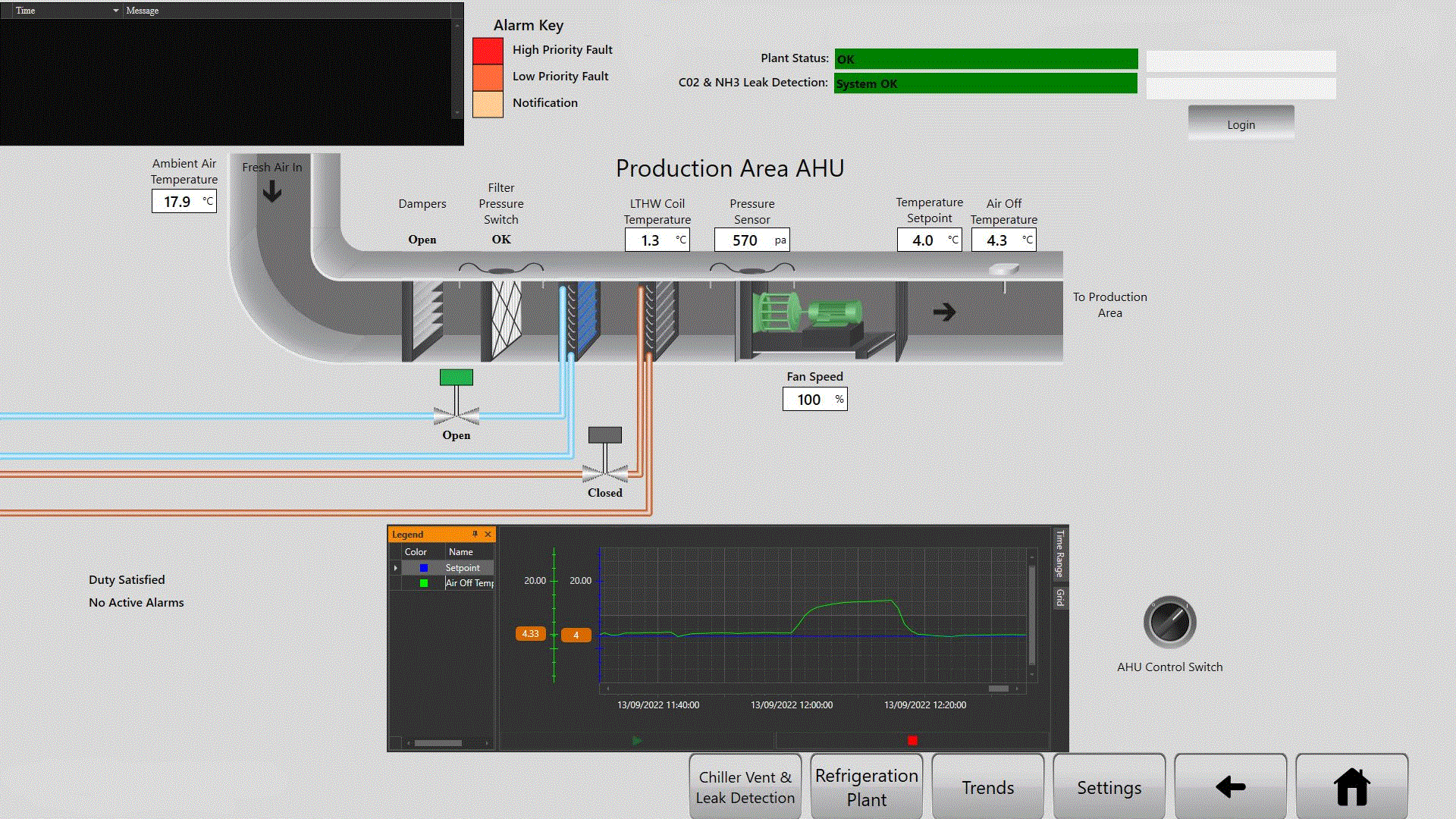
Many industrial failures are not instantaneous. They develop over hours, days, or weeks. SCADA trending allows you to see instability, cycling, drift, and abnormal patterns that would never be obvious from a momentary reading. SCADA systems store historical data, which is essential for trend analysis and gaining long-term insights into system performance.
ℹ Engineering Reality: Trend data is often more valuable than “live” data, because it shows whether a system is stable, degrading, or being operated outside design intent.
SCADA systems provide extensive data analytics, logging, and reporting capabilities, supporting data-driven decision-making.
3) Alarm management - structured response instead of noise
Alarm visibility is only useful if alarms are engineered. SCADA classify alarms by severity, suppress irrelevant nuisance alarms, enforce acknowledgement rules where appropriate, and provide context so operators can respond quickly. Effective alarm management is a key component of SCADA solutions, supporting automation, regulatory compliance, and operational efficiency.
❗ Important: Poor alarm philosophy creates alarm flooding and operator desensitisation. SCADA must be configured to prioritise what threatens safety, product, or uptime - not every minor deviation.
4) Root-cause support - faster fault-finding
SCADA improves engineering response by exposing interlock status, permissive chains, sequence steps, and event logs. Instead of guessing, engineers can identify what condition prevented start, what triggered a trip, and what changed immediately beforehand.
A proactive approach enabled by SCADA diagnostics allows engineers to address issues before they escalate, reducing downtime and improving reliability.
✅ Outcome: Sites with strong SCADA diagnostics typically reduce fault-finding time because engineers can see the sequence, the trip condition, and the trend - without dismantling panels or relying on memory.
SCADA Software and Industrial Cybersecurity
SCADA software is at the heart of modern industrial automation, enabling organisations to control industrial processes, optimise operational efficiency, and monitor critical infrastructure across vast, distributed systems. As SCADA systems connect more devices—such as remote terminal units (RTUs), programmable logic controllers (PLCs), and field devices—across long distances and remote locations, the risk of cyber threats targeting these environments has grown dramatically.
Industrial cybersecurity is now a fundamental requirement for any company relying on SCADA to manage automated processes and ensure the reliability of critical infrastructure. Cyber threats can exploit vulnerabilities in SCADA software, legacy systems, or unsecured communication channels, potentially disrupting operations, compromising data integrity, or even causing physical damage to equipment. Attacks on SCADA systems can have far-reaching consequences, especially in sectors like energy, water treatment, and oil and gas pipelines, where process control and data acquisition are essential for safety and compliance.
To address these risks, organisations must implement effective strategies that protect both the technology and the processes it supports. This includes segmenting networks to isolate SCADA components, using data encryption for secure data transfer, and enforcing strict access controls for remote access to control equipment. Regularly updating SCADA software, monitoring for unusual activity, and conducting vulnerability assessments are also critical steps in defending against cyber threats.
By prioritising industrial cybersecurity, companies not only safeguard their SCADA systems and critical infrastructure but also enhance operational efficiency and reliability. Secure SCADA environments enable operators to focus on process optimisation, proactive maintenance, and decision making—without the constant threat of cyber disruption. In today’s landscape of modern industrial automation, robust cybersecurity is as essential as the SCADA technology itself, ensuring that organisations can continue to collect data, control processes, and deliver productivity with confidence.
How SCADA Supports Compliance and Audit Readiness
In compliance-sensitive industries, you don’t just need safe systems - you need evidence. SCADA helps create that evidence by logging key parameters, storing alarm history, and producing reports that demonstrate control and response.
For food manufacturing and temperature-critical environments, SCADA can support:
Traceability - time-stamped records of temperatures, process states, and alarms
Exception reporting - identifying excursions, deviations, and response actions
Maintenance evidence - logs that support preventive maintenance planning and defect close-out
Operational discipline - demonstrating that alarms are monitored and acted upon
⚠ Audit Warning: If SCADA data exists but retention, access control, or reporting is weak, auditors may treat it as unreliable evidence - especially if event history cannot be produced consistently.
Engineering Considerations That Determine Whether SCADA Delivers Real Visibility
SCADA success is engineering-led. Visibility improves when system architecture, instrumentation, data structure, and human factors are designed properly.
Industrial connectivity remains a critical aspect of SCADA systems, as it simplifies the integration between the shop floor and SCADA, as well as other consuming systems.
📋 The SCADA Visibility Engineering Checklist
Data integrity - sensors calibrated, signals validated, and PLC tags correctly scaled
Architecture - resilient comms, network segmentation, and controlled remote access
Alarm philosophy - severity levels, prioritisation, suppression, and response expectations
Historian and retention - trends stored at meaningful resolution with appropriate retention periods
HMI usability - screens designed for decisions, not decoration
Documentation - tag lists, drawings, backups, and change control
Data quality first - garbage in, garbage out
If sensors drift, scaling is wrong, or PLC logic is undocumented, SCADA will simply display inaccurate information faster. Visibility depends on data integrity.
❌ Common Mistake: Building SCADA screens before validating instrumentation, calibration, scaling, and PLC tag consistency.
Network and resilience - visibility must survive incidents
If SCADA fails when you need it most - during a trip, power quality event, or network fault - you lose the very evidence that supports fault-finding and audit response. Resilience matters: UPS where needed, industrial networking, segmentation, and monitored comms health.
ℹ Pro Tip: Treat comms health as a monitored asset. SCADA should alarm on lost comms, stale values, and historian failures - otherwise you may assume you have visibility when you don’t.
Human factors - visibility must match operator decisions
A screen that shows everything shows nothing. The best SCADA designs focus on the decisions operators and engineers must make: what changed, what is abnormal, what is the likely consequence, and what action is required.
💡 Design Tip: Build screens around operational questions: “Is the line stable?”, “What is at risk?”, “What tripped?”, “What should I check first?”, and “How long has this been drifting?”
Preventive Measures Enabled by SCADA
SCADA is not preventive maintenance on its own, but it strengthens preventive measures by providing the signals and evidence needed to move from time-based maintenance to condition-led maintenance. Predictive maintenance, supported by AI-driven analytics in SCADA, can predict equipment failures by identifying patterns in sensor data and reduce downtime by up to 15%.
Examples of preventive measures SCADA can support include:
Condition monitoring triggers - abnormal motor current, overheating indicators, compressor cycling rates
Alarm pattern analysis - repeated trips indicating failing components or control instability
Maintenance scheduling - using runtime hours and load profiles to plan interventions
Verification checks - confirming that remedial works actually stabilised the process
☑ SCADA-Enabled Prevention Checklist
✅ Define critical assets and critical variables (product, safety, uptime)
✅ Trend the variables that indicate drift or degradation
✅ Configure alarm priorities aligned to operational consequence
✅ Implement event logs and time-stamped trip capture
✅ Set retention and reporting aligned to audit and investigation needs
✅ Review alarm and trend data monthly as part of preventive maintenance governance
How Modern SCADA Improves Reliability and Operational Performance
Modern SCADA systems are not limited to on-site screens. They can provide controlled remote visibility, role-based access, structured reporting, and integration with maintenance workflows - when engineered securely and with clear governance.
In production-critical environments, reliability improves when SCADA supports:
Earlier intervention - catching drift before it becomes downtime
Faster recovery - clearer trip diagnosis and response
Reduced repeat failures - using history to eliminate root causes
Better compliance posture - consistent reporting and evidence
Lifecycle control - documented changes, backups, and supportability
💡 Key Insight: SCADA delivers the highest reliability gains when it is paired with control panel modernisation, documented PLC logic, and a structured preventive maintenance regime - not when it’s bolted on as an afterthought.
How JBB Applies SCADA Within Assess → Modernise → Protect → Prevent → Support
JBB Electrical applies SCADA as part of a wider compliance and uptime engineering approach. SCADA acts as a connectivity layer, allowing organisations to integrate more devices and improve data sharing capabilities across their infrastructure. Visibility is only valuable when it connects to risk reduction and operational control.
📋 JBB Approach to SCADA Visibility
Assess - identify where you lack visibility, what risks are hidden, and where data integrity is weak
Modernise - upgrade panels, PLC platforms, and instrumentation so SCADA has reliable signals to work with
Protect - engineer alarm priorities, monitoring, and safeguards around product and uptime risk
Prevent - use trends, events, and reports to drive condition-led interventions and governance
Support - maintain backups, documentation integrity, lifecycle plans, and ongoing SCADA optimisation
Request a Compliance and Breakdown Prevention Assessment
If you suspect your operation is running with blind spots - limited alarm governance, weak trend capture, undocumented PLC logic, or fragmented monitoring - a structured assessment will clarify where risk is accumulating and what to prioritise.
JBB Electrical’s Compliance and Breakdown Prevention Assessment identifies visibility gaps, lifecycle risks, documentation weaknesses, and practical engineering measures to improve SCADA performance, compliance evidence, and uptime protection.
Request a Compliance and Breakdown Prevention Assessment to move from reactive monitoring to engineered visibility.
Frequently Asked Questions
What risks does poor visibility create in industrial operations?
Poor visibility increases downtime risk, extends fault-finding time, and weakens operational control. It also creates compliance exposure because you may be unable to prove what happened, when it happened, and how your team responded - particularly in temperature-critical and production-critical environments.
How does compliance affect SCADA design and operation?
Compliance demands evidence, traceability, and controlled access. SCADA must therefore be engineered with reliable data sources, meaningful retention, consistent reporting, and documented change control - otherwise it may be treated as unreliable during audits or incident investigations.
What preventive measures should be taken alongside SCADA?
Combine SCADA with preventive maintenance governance: thermal imaging, defect reporting and close-out, instrument calibration, panel inspections, alarm philosophy reviews, PLC backup and lifecycle control, and a critical spares strategy. SCADA strengthens these measures by providing trends, events, and performance evidence.