Industrial control panels form the nerve centre of manufacturing operations, managing everything from motor control circuits to complex automation sequences. A poorly designed control panel creates operational risks that compound over years — unexpected downtime, safety hazards, and compliance failures that could have been eliminated through systematic design protocols.
Effective control panel design requires integrating multiple engineering disciplines: electrical design principles, component selection criteria, compliance frameworks, and integration protocols. Each decision during the design phase affects reliability, maintainability, and future expansion capability.
Understanding Industrial Control Panel Fundamentals
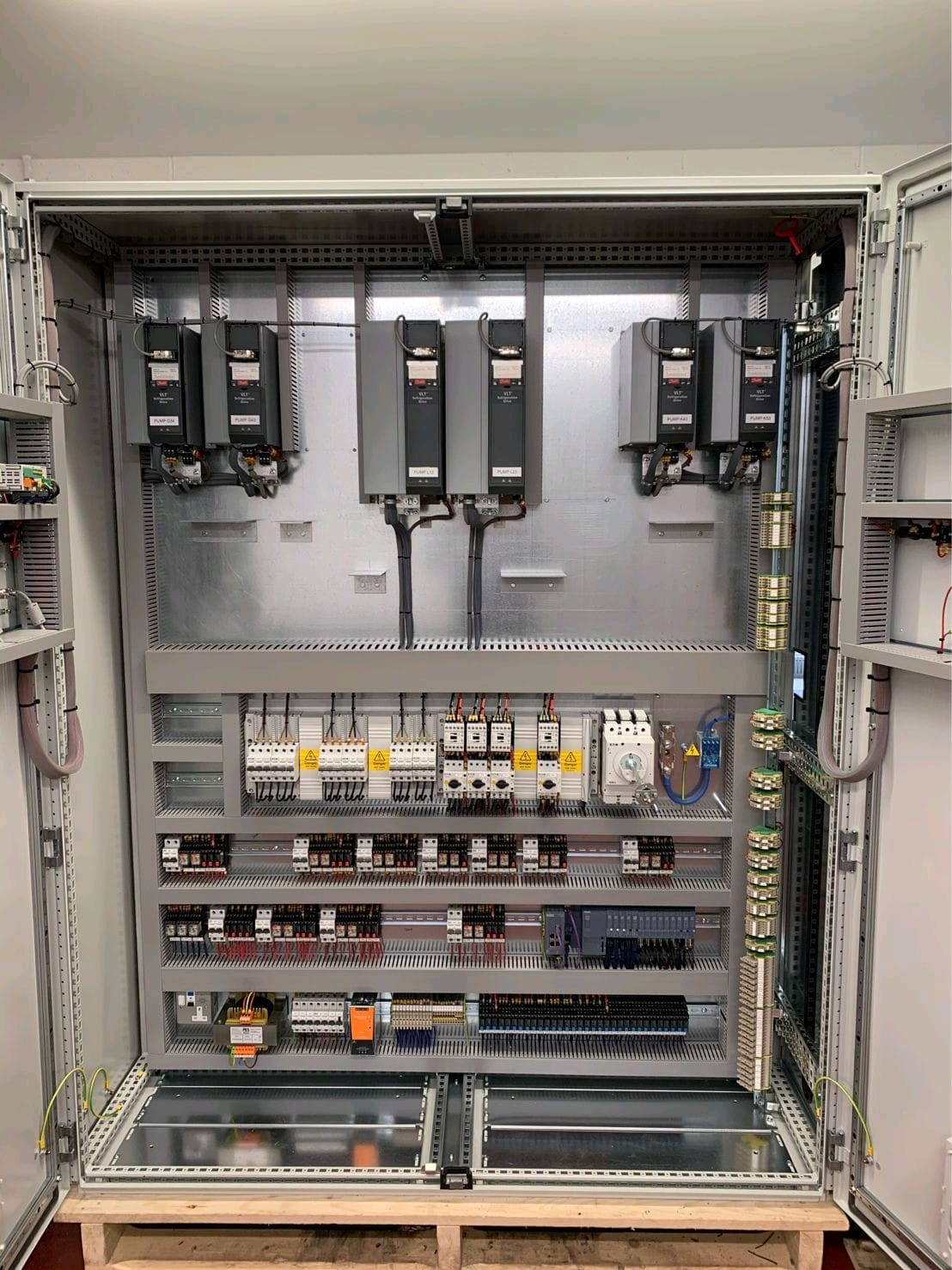
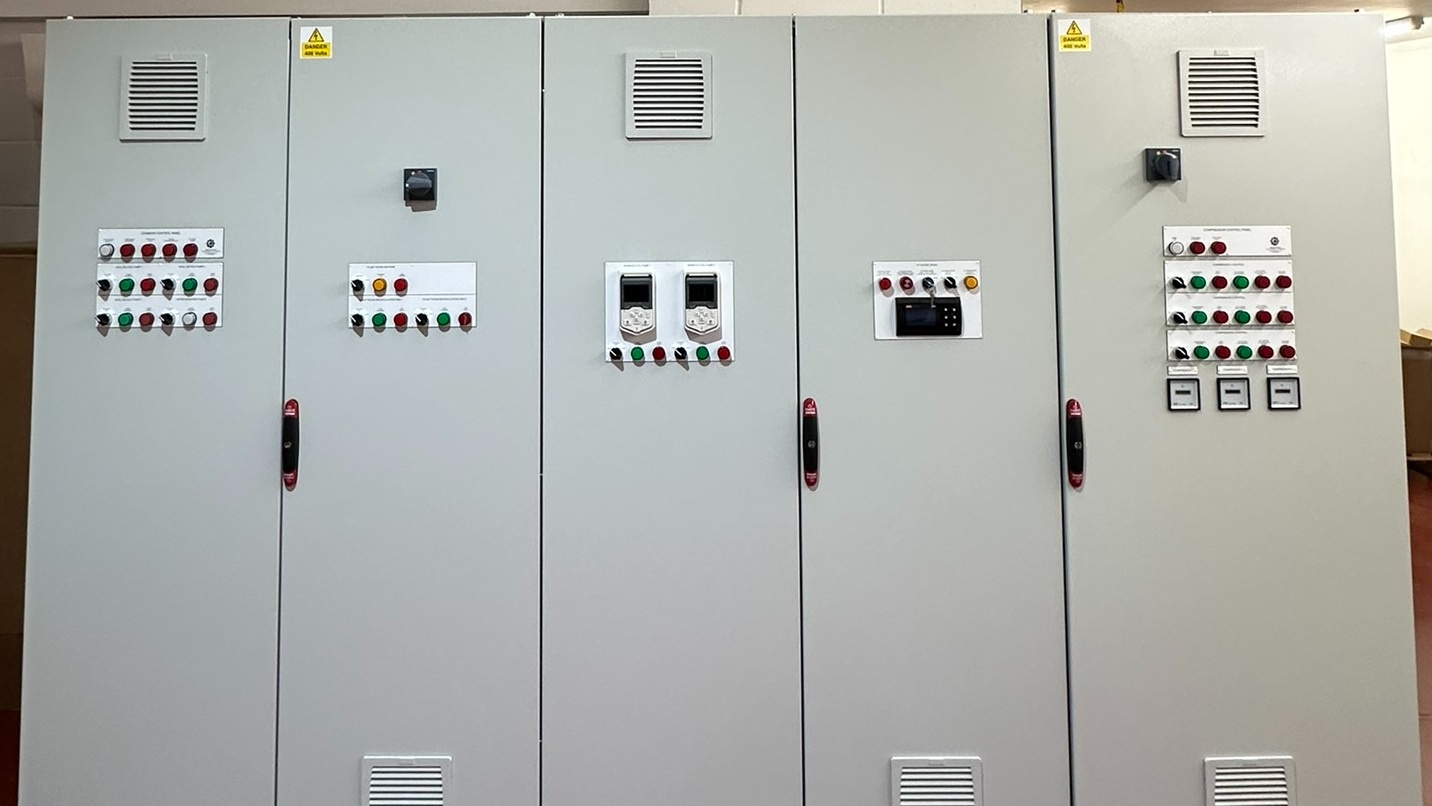
Industrial control panels coordinate electrical power distribution, protection, and control logic across manufacturing systems. They house motor control circuits, protection devices, PLCs, and interface equipment within a structured enclosure that provides safe access for operation and maintenance.
Modern control panels integrate multiple functions within a single cabinet:
- Power distribution through contactors and motor control centres
- Protection systems including circuit breakers and overload relays
- Control logic via programmable logic controllers
- Human-machine interfaces for operator control
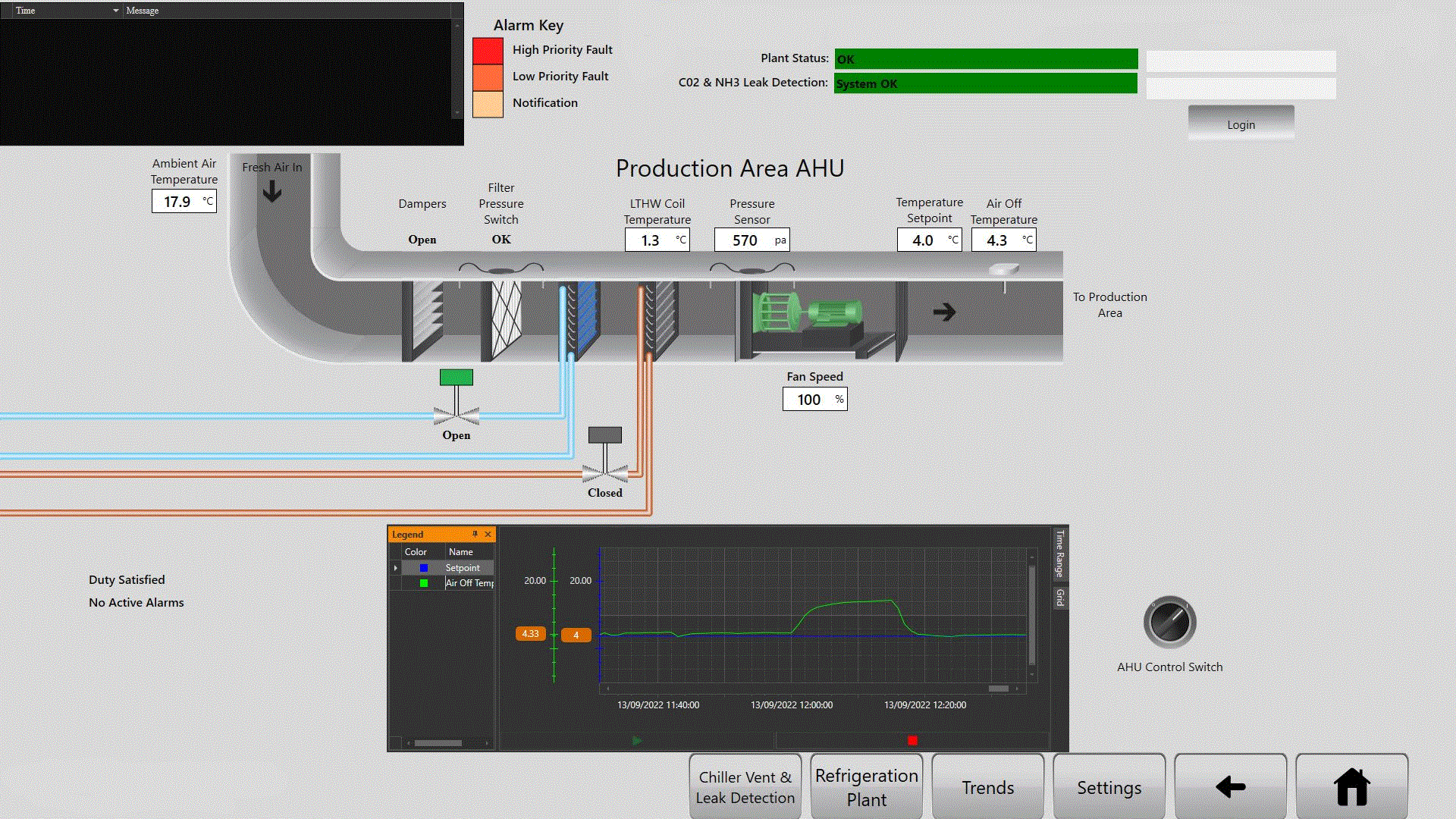
- Communication modules for SCADA integration
The panel's electrical architecture determines operational reliability. A well-designed panel isolates faults, provides clear diagnostic information, and supports maintenance activities without system shutdown. Poor architecture creates single points of failure and maintenance hazards.
📖 Control Panel Architecture:
The systematic arrangement of power distribution, protection, control, and interface components within an enclosure, designed to provide safe and reliable control of industrial processes while meeting regulatory requirements and operational needs.
Component layout affects both safety and efficiency. Related functions should be grouped logically, with clear separation between high and low voltage circuits. Cable routing must minimise electromagnetic interference while providing accessible termination points for field connections.
Design Principles for Reliable Control Systems
Reliable control panel design follows systematic protocols that eliminate hazards and ensure compliance with BS EN 60204-1 requirements. These protocols address electrical safety, functional reliability, and maintainability from the initial specification stage.
Safety isolation forms the foundation of control panel design. Each circuit requires appropriate disconnection means, with emergency stop functions integrated into the overall safety architecture. Protection devices must discriminate properly, ensuring faults clear at the lowest possible level without affecting unrelated circuits.
Component selection follows a hierarchy of requirements:
- Safety and protection requirements per BS EN 60204-1
- Operational performance specifications
- Environmental conditions and IP ratings
- Maintenance accessibility and service life
- Integration with existing automation platforms
Thermal management prevents component degradation and extends service life. Internal layout must provide adequate ventilation, with heat-generating components positioned to promote natural convection. Forced cooling may be required in high-density panels or harsh environments.
📌 Protection Discrimination:
Protection devices must be coordinated so that upstream devices only operate when downstream protection fails to clear a fault. This prevents unnecessary shutdown of unaffected circuits during fault conditions.
Documentation quality directly affects long-term reliability. Complete schematic drawings, component schedules, and terminal lists enable efficient troubleshooting and modification. Each component must be clearly identified with unique references that match the physical installation.
Component Selection and Specification Requirements
Component specification determines both immediate performance and long-term reliability. Each component must meet the electrical requirements, environmental conditions, and integration protocols specific to the application.
Contactors and motor control devices require careful sizing for the specific load characteristics. Motor starting current, duty cycle, and switching frequency all affect component selection. Oversizing provides operational margin but increases cost and panel space requirements.
Consider these critical selection criteria:
- Electrical ratings with appropriate derating for temperature and altitude
- Mechanical life and electrical endurance specifications
- Environmental ratings for temperature, humidity, and contamination
- Integration compatibility with control systems and communication protocols
- Spare parts availability and manufacturer support
PLC platform selection affects both current functionality and future expansion capability. Established platforms like Siemens, Allen-Bradley, and RDM offer comprehensive module ranges and long-term support. Platform choice should align with existing site infrastructure and maintenance capabilities.
📋 The JBB Control Panel Design Methodology:
Assess: We analyse load requirements, environmental conditions, safety functions, and integration needs to establish complete technical specifications before component selection begins.
Modernise: Panel architecture incorporates current technology standards with provisions for communication protocols, diagnostic capabilities, and remote monitoring integration where operational benefits justify the investment.
Protect: Protection schemes provide discrimination and selectivity, ensuring faults clear at the appropriate level while maintaining supply to unaffected circuits through properly coordinated circuit breakers and overload devices.
Prevent: Design protocols eliminate common failure modes through component derating, thermal management, electromagnetic compatibility measures, and systematic testing procedures that verify performance before commissioning.
Support: Comprehensive documentation packages include as-built drawings, component specifications, testing certificates, and maintenance procedures that enable efficient operation and future modifications by site personnel.
Interface devices require specification for both technical performance and operator requirements. Push buttons, selector switches, and indicator lights must provide clear indication under the ambient lighting conditions. Emergency stop devices require positive opening action and clear visual identification.
Compliance Standards and Safety Requirements
BS EN 60204-1 provides the fundamental safety requirements for electrical equipment in machinery applications. Compliance with this standard is mandatory for industrial control panels, covering electrical safety, protection, and control circuit requirements.
Key compliance areas include:
- Supply disconnection and isolation requirements
- Protection against electric shock and fault conditions
- Emergency stop function implementation
- Control circuit integrity and reliability
- Documentation and marking requirements
Protection against indirect contact requires automatic disconnection of supply within specified time limits. Residual current devices or protective equipotential bonding may be necessary depending on the earthing system and fault loop impedance values.
⚠️ Emergency Stop Requirements:
Emergency stop devices must be readily accessible, clearly identified, and designed to prevent inadvertent operation while ensuring positive action when activated. The function must override all other control functions and maintain the safe state until manually reset.
Control circuit integrity becomes critical where safety functions depend on control system operation. Category ratings under BS EN ISO 13849-1 define the required architecture and component selection for safety-related control systems. Higher category ratings require redundant components and fault detection capabilities.
Testing and verification procedures must demonstrate compliance before commissioning. Insulation resistance testing, earth continuity verification, and functional testing of protective devices confirm that installation meets the design requirements.
Integration with Automation Infrastructure
Modern control panels must integrate seamlessly with facility automation systems, providing process data, alarm information, and remote control capabilities. Integration architecture affects both current functionality and future expansion possibilities.
Communication protocols determine how effectively the panel integrates with existing SCADA systems. Ethernet-based protocols provide high-speed data exchange and diagnostic capabilities, while serial protocols may be necessary for integration with legacy systems.
Network topology affects system reliability and performance. Star configurations provide individual connections to each device but require more infrastructure. Bus topologies reduce wiring requirements but create potential single points of failure that must be addressed through redundancy or alternative communication paths.
Data mapping requirements must be established during the design phase. Critical process variables, alarm conditions, and control functions require consistent addressing schemes that align with the overall automation architecture. Changes to data structures after commissioning create significant modification costs.
🧪 SCADA Integration Architecture:
Consider a motor control centre serving a food processing line where the PLC communicates production data, motor status, and alarm conditions to the facility SCADA system via Ethernet/IP protocol. An engineer would configure data tags for motor current, runtime hours, and fault status, with alarm limits set for overcurrent and mechanical fault detection. The integration enables predictive maintenance scheduling based on motor loading trends and provides immediate notification of fault conditions that could affect production continuity. Illustrative example based on representative JBB project work.
Cybersecurity considerations have become essential for networked control systems. Network segmentation, access control, and secure communication protocols protect against unauthorised access while maintaining operational functionality.
Quality Testing and Certification Processes
Systematic testing procedures verify that completed panels meet design specifications and regulatory requirements before installation. Testing protocols must address both safety compliance and functional performance.
Factory acceptance testing validates panel construction and functionality in a controlled environment. This testing includes:
- Visual inspection of workmanship and component installation
- Electrical testing of insulation resistance and earth continuity
- Functional testing of all control circuits and interlocks
- Communication testing with connected systems
- Performance verification under rated load conditions
Insulation resistance testing must demonstrate adequate insulation between live conductors and earth, and between circuits operating at different voltages. Test voltages and minimum resistance values are specified in BS 7671 and BS EN 60204-1.
🗒 Testing Sequence:
Testing follows a logical sequence from basic electrical safety through functional verification to system integration, with each stage building on the previous results to confirm overall system integrity and performance.
Documentation packages accompany completed panels, providing installation drawings, testing certificates, and operational procedures. This documentation enables efficient commissioning and provides the foundation for ongoing maintenance activities.
Third-party certification may be required for specific applications or export markets. Certification bodies verify compliance with applicable standards and provide independent verification of safety and performance claims.
Future-Proofing and Expansion Planning
Effective control panel design accommodates future modifications and regulatory changes without requiring complete reconstruction. This requires systematic consideration of spare capacity, space allocation, and component obsolescence planning.
Electrical capacity planning should include provisions for additional circuits based on anticipated facility growth. Spare ways in distribution boards, unused PLC I/O capacity, and appropriately sized feeders provide expansion capability without panel modifications.
Physical space allocation affects modification costs significantly. Panels designed with expansion space enable additional components to be installed efficiently. Inadequate space forces external additions that compromise the original design integrity.
Component lifecycle planning addresses obsolescence risks before they affect operations. Established product families with long-term manufacturer support reduce replacement risks. Where obsolescence is anticipated, migration paths to current technology should be identified during the design phase.
💭 Expansion Design:
Reserve 25% spare capacity in switchgear and 30% spare I/O capacity in PLC systems to accommodate future requirements without major modifications.
Regulatory updates may require panel modifications to maintain compliance. Design approaches that exceed minimum requirements provide margin for regulatory changes, while systematic documentation enables efficient compliance verification during updates.
The JBB Control Panel Design Methodology
📋 The JBB Control Panel Design Methodology:
Assess: We analyse operational requirements, safety functions, environmental conditions, and integration protocols to establish comprehensive design specifications that address both immediate needs and future expansion requirements.
Modernise: Control panel architecture incorporates current protection standards, communication capabilities, and diagnostic functions while ensuring compatibility with existing automation platforms like Siemens, Allen-Bradley, and RDM systems.
Protect: Protection schemes provide proper discrimination and coordination, with circuit breakers, overload relays, and emergency stop systems configured to clear faults at appropriate levels while maintaining supply to unaffected circuits.
Prevent: Design protocols eliminate common failure modes through systematic component derating, thermal management, EMC measures, and comprehensive factory acceptance testing that verifies performance before site installation.
Support: Complete documentation packages include schematic drawings, component schedules, testing certificates, and maintenance procedures that enable efficient troubleshooting, modification, and compliance verification throughout the panel's service life.
This methodology ensures control panels meet operational requirements while maintaining compliance and supporting future facility growth. Same team: design, build, test, document approach eliminates accountability gaps that arise when these functions are divided between different contractors.
Next Step: Request a Compliance & Breakdown Prevention Assessment
A Compliance & Breakdown Prevention Assessment identifies the control panel, component, software, and documentation risks affecting your operation - from panel compliance and thermal condition, through PLC platform obsolescence, to undocumented control logic that cannot be safely modified. It sets out the engineering actions needed to modernise, document, and protect your automation estate. Request a Compliance & Breakdown Prevention Assessment today to establish the engineering foundation for reliable control panel performance and regulatory compliance.
Our PLC Programming & Automation Software Development service provides the control logic and integration capabilities that transform electrical panels into complete automation solutions.