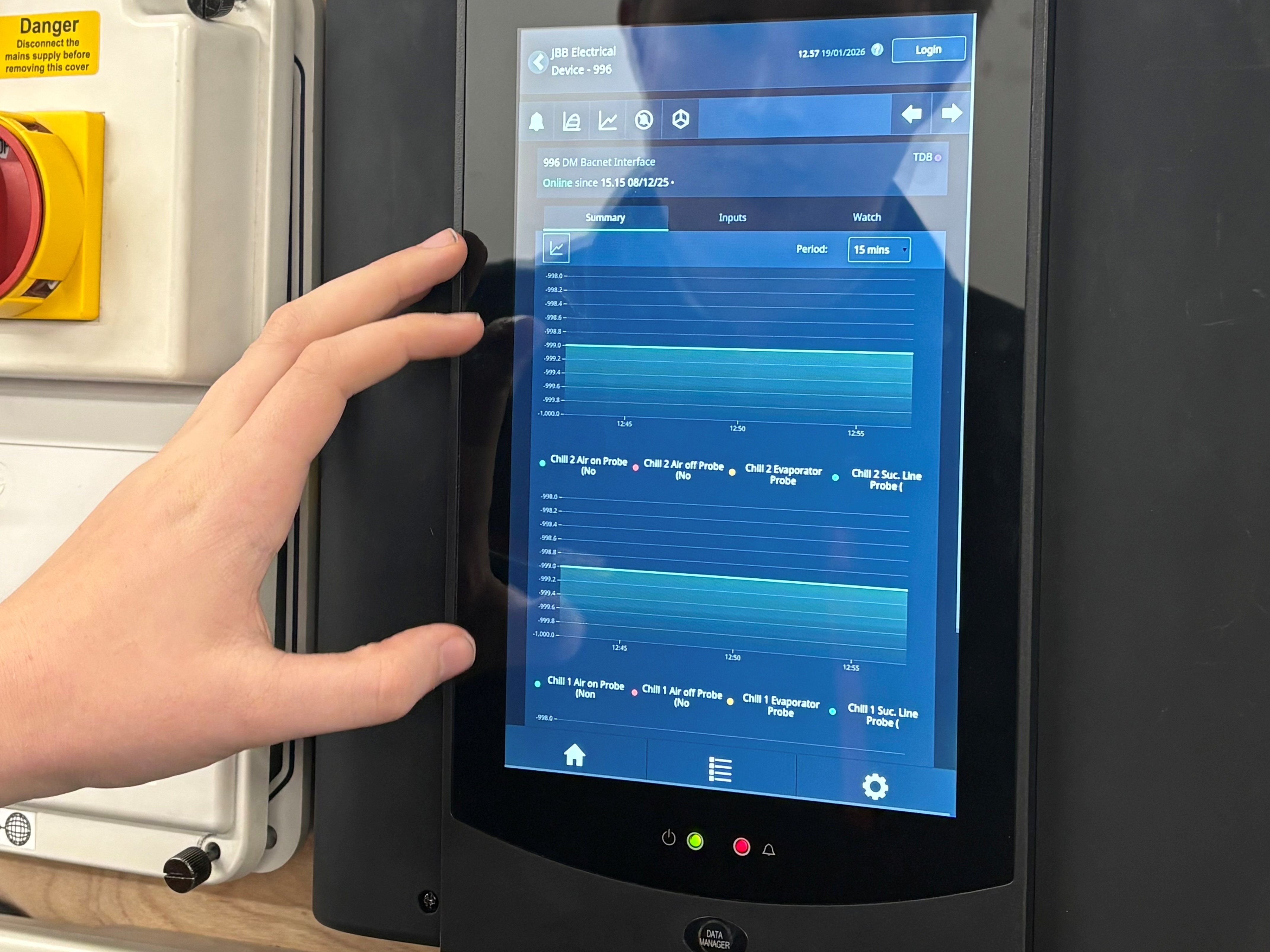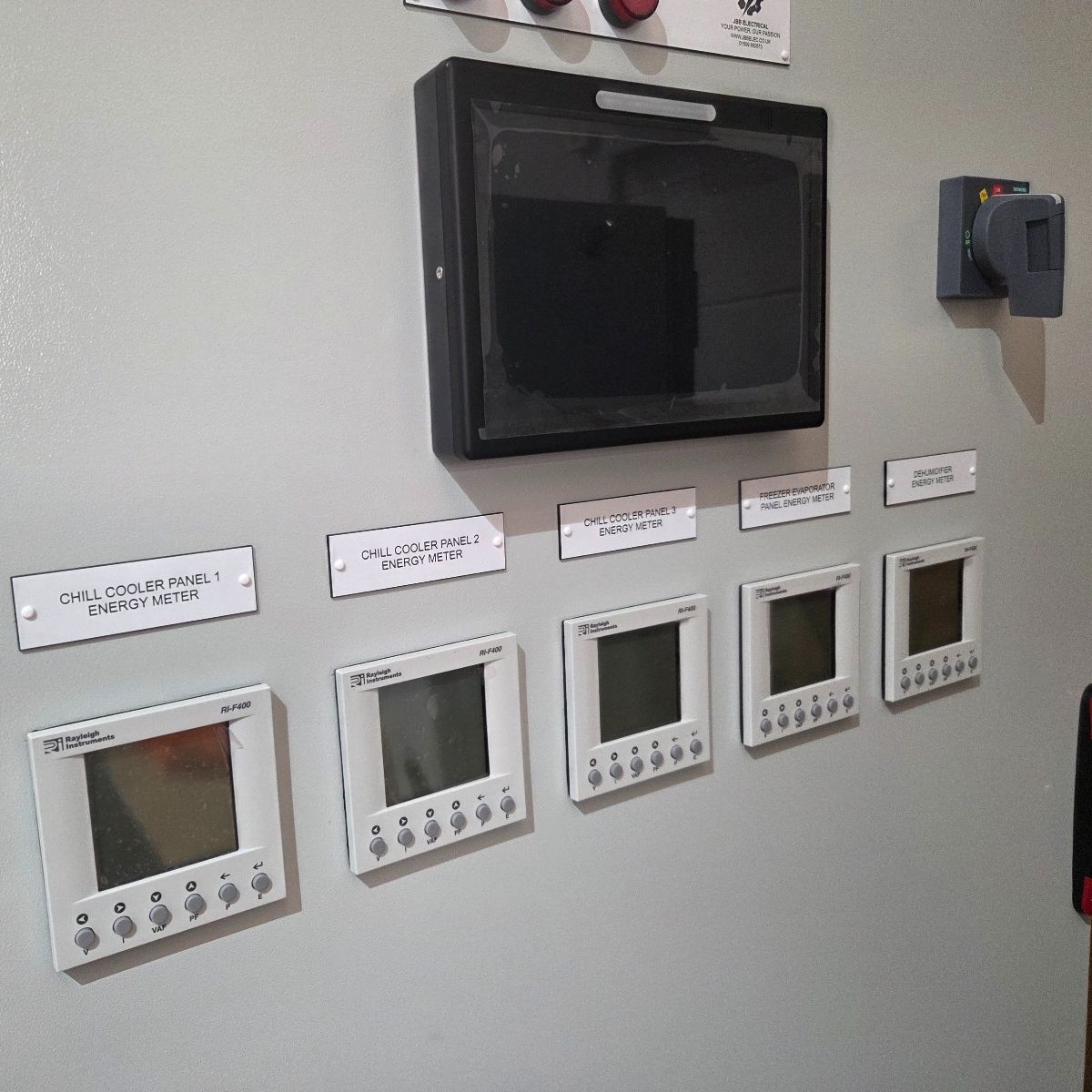
A refrigeration control panel that cannot produce continuous, retrievable temperature records is not just an engineering problem - it is a compliance liability. When BRC, SALSA, or HACCP auditors ask for historical temperature data, alarm acknowledgement logs, and calibration certificates, the panel architecture either delivers that evidence or it does not.
The decisions made during panel specification and design determine whether your temperature compliance evidence is defensible or full of gaps. This article covers the specific design features that separate audit-ready refrigeration control panels from those that create risk.
Why Refrigeration Panel Design Is a Compliance Decision, Not Just an Engineering One
The instinctive response to a compliance gap is to retrofit a solution - add a data logger here, connect an alarm system there. That approach consistently fails because the compliance architecture of a refrigeration control panel cannot be reliably added after the fact.
Alarm management, data logging, probe input configuration, and escalation logic all interact with the panel's control architecture. When those elements are designed in from the start, they operate as an integrated system. When they are bolted on later, the result is typically data format inconsistencies, configuration limitations, and gaps in the evidence chain that experienced auditors identify immediately.
Food manufacturing, cold storage, and pharmaceutical operations all share the same audit expectation: temperature records must be continuous, tamper-evident, retrievable, and traceable to calibrated sensors. The panel either provides that infrastructure or it does not. There is no middle ground that satisfies a serious audit.
Compliance by design, not retrofit
Alarm setpoints, escalation logic, data logging intervals, and probe calibration integration must be specified at the panel design stage. Retrofitting these features after installation introduces configuration gaps and data continuity risks that create audit vulnerabilities - often in the records that auditors examine most closely.
Data Logging Requirements for BRC, SALSA, and HACCP: What Your Panel Must Provide
BRC Global Standards, SALSA certification, and HACCP-based food safety management systems all require continuous, retrievable temperature records for controlled environments and product storage areas. The specific data your panel must capture includes:
Temperature readings at defined intervals - typically one reading every 15 minutes as a minimum, with shorter intervals for critical processes
Timestamped records with sufficient resolution to reconstruct the thermal profile of any period under investigation
Data retention extending to at least 12 months for most food safety schemes, with some regulatory contexts requiring longer periods
Tamper-evident records - either through sealed logging hardware or audit trail functionality that records any configuration change
Retrievable format - records that can be exported in a readable format for auditor review without requiring specialist software access
Panel-integrated data logging - where the logging function sits within the control panel's own architecture, connected directly to calibrated probes - is the most reliable configuration. External loggers connected to panel outputs introduce an additional layer of potential discontinuity and create questions about the integrity of the data chain.
The logging interval question deserves particular attention. A 30-minute logging interval may appear adequate under normal conditions but will fail to capture a short excursion that breaches critical limits within that window. A panel designed for compliance specifies logging intervals based on the thermal characteristics of the controlled environment and the speed at which temperature can change - not on a default setting left in place from commissioning.
Alarm Configuration That Satisfies Auditors: Setpoints, Escalation Logic, and Response Records
Alarm management is where many refrigeration control panels fail at audit - not because the alarms do not trigger, but because the records do not demonstrate that the alarm was received, acknowledged, and responded to within a defined timeframe.
An audit-ready refrigeration control panel requires three distinct alarm configuration elements:
Defined setpoints - upper and lower temperature thresholds validated against product safety requirements and documented in the panel configuration records
Escalation logic - a defined sequence specifying who is notified, by what method, and after how long if the alarm is not acknowledged; this sequence must be documented and tested
Timestamped acknowledgement logging - a record of when each alarm triggered, when it was acknowledged, and what action was taken; this is the element most commonly missing from retrofitted systems
Auditors conducting BRC or regulatory inspections do not simply check that alarms exist. They review the alarm log to establish whether alarms were acknowledged promptly, whether response times are consistent with the documented procedure, and whether any alarms were silenced without corrective action being recorded. A panel that triggers alarms but cannot produce the acknowledgement record fails that part of the audit.
Setpoint drift - a quiet compliance failure
Alarm setpoints that have drifted from validated parameters over time are a common audit finding. When a setpoint is manually adjusted at the panel without a corresponding update to the configuration record, the documented alarm threshold no longer matches the installed configuration. Auditors check both. Panel designs that enforce change authorisation and log configuration edits with timestamps eliminate this vulnerability.
How UKAS Traceable Probe Calibration Makes Temperature Data Defensible
A refrigeration control panel records what its sensors report. If those sensors are drifting, uncalibrated, or operating outside their specification range, the temperature records the panel produces are unreliable - regardless of how sophisticated the logging system is.
UKAS traceable calibration of thermocouples, RTDs, and digital temperature sensors is what converts a temperature record into legally and auditably defensible evidence. The traceability chain - from your installed probe, through the reference standard used for calibration, to the national measurement standard - is what an auditor is verifying when they ask for calibration certificates.
Panel design must accommodate calibration as a routine operational activity, not an exceptional intervention. This means:
Probe inputs designed to accept calibrated replacement sensors without requiring panel modification
Calibration due-date tracking integrated into the panel's maintenance schedule or HMI display
Documentation architecture that links each probe's calibration certificate to the data records it generated during that calibration period
Probe placement that allows access for in-situ calibration checks without disrupting the controlled environment
An uncalibrated probe does not produce inaccurate records in an obvious way - it produces records that look normal but cannot be defended. When an auditor asks what evidence exists that the sensor reading at 3:00 AM last Tuesday was accurate, the answer must be a calibration certificate with a current validity date and a traceable reference. Anything less is not an answer that satisfies a serious food safety or pharmaceutical audit.
Investigating Temperature Excursions: The Historical Data Trail Auditors Expect
When a temperature excursion occurs - whether identified during monitoring or flagged at audit - the investigation requires more than the point of excursion. Auditors and regulatory inspectors expect to see the complete thermal event: the trend leading up to the breach, the peak or trough, and the full recovery period.
That requires continuous historical data with sufficient logging resolution to reconstruct the event. A panel logging at 30-minute intervals cannot tell you whether a 45-minute excursion occurred between readings. A panel logging at 5-minute intervals can reconstruct the event precisely, identify when it began, confirm when temperature returned to safe parameters, and provide the evidence needed to demonstrate corrective action was effective.
Illustrative example - representative of the engineering pattern, not a documented JBB project
Consider a cold store distribution facility operating under BRC audit where a temperature excursion is flagged during a third-party inspection. The auditor requests the 72-hour temperature record surrounding the event. The installed refrigeration control panel - a unit not originally designed for compliance data logging - produces records at 30-minute intervals with a 90-day retention window. The auditor identifies three concerns: the logging interval is insufficient to confirm whether temperature remained outside limits for a food-safety-critical period; the alarm log shows the high-temperature alarm triggered but contains no acknowledgement record; and one of the two probe calibration certificates is 14 months out of date. The engineering response would be to replace the panel's logging module with a compliant unit configured for 5-minute intervals and 13-month retention, implement alarm acknowledgement logging in the control logic, and immediately commission UKAS traceable calibration of all installed probes. The excursion itself may have been minor - but the panel's inability to produce defensible records creates a major non-conformance that the excursion alone would not have caused.
Common Panel Design Shortcomings That Create Compliance Gaps
The compliance gaps that emerge during BRC, SALSA, and regulatory audits of refrigeration systems are rarely caused by refrigeration equipment failure. They are caused by panel design decisions - or the absence of design decisions - that leave the evidence infrastructure incomplete.
The most consistent shortcomings encountered in facilities with audit exposure are:
Data retention periods shorter than audit requirements - panels configured with 30 or 90-day retention when the audit framework requires 12 months or more
Missing alarm acknowledgement records - alarm events are logged but operator responses are not, leaving no evidence that action was taken
Uncalibrated or overdue sensors - probe calibration is not tracked at the panel level, and certificates expire without triggering a maintenance action
Setpoints not matching validated parameters - alarm thresholds adjusted at the panel without updating the documented configuration, creating a discrepancy auditors will find
Retrofit logging incompatibility - external data loggers added to existing panels produce data in formats that do not align with the panel's own records, creating gaps and inconsistencies in the historical trail
Insufficient logging resolution - recording intervals too long to reconstruct a temperature excursion with the precision required for root cause analysis and corrective action demonstration
Each of these shortcomings is preventable at the design stage. They become expensive remediation projects once a panel is installed and in service - and in the worst case, they produce non-conformances that cannot be remediated quickly enough to protect product or satisfy a regulatory notice.
Specifying a Refrigeration Control Panel for Audit Readiness
Specifying a refrigeration control panel for audit readiness requires the compliance evidence requirements to drive the panel design - not the other way around. The starting point is the audit framework your operation is subject to: BRC, SALSA, HACCP, or a combination, along with any applicable regulatory requirements from the Food Standards Agency or MHRA in pharmaceutical contexts.
From those requirements, the specification should define data retention duration, logging interval, alarm management architecture, calibration integration, and documentation requirements before panel design begins. JBB Electrical's Refrigeration Control Systems service is designed to deliver precisely this sequence — a panel built to a compliance specification will satisfy audit. A panel built to an engineering specification and then adapted for compliance typically will not.
Specification checklist: audit-ready refrigeration panel
Confirm the following before panel design is finalised: data logging interval defined and validated against thermal event speed; data retention period specified and meeting audit framework requirements; alarm setpoints drawn from validated parameters and locked against unauthorised change; escalation logic documented and testable; alarm acknowledgement logging enabled in the control architecture; probe calibration schedule integrated and tracked at panel level; and all configuration changes logged with timestamp and user identification.
The electrical installation supporting the panel must also meet BS 7671 requirements. Depending on the application, the wider project may also need to consider the Electricity at Work Regulations 1989, PUWER, BS EN 60204-1 for machinery electrical systems, and IEC 62443 where cybersecurity of industrial control systems is relevant. A panel specified correctly for compliance but connected through non-compliant power distribution or inadequate earthing introduces a separate category of audit exposure and insurance risk — one that sits outside the panel specification itself but is equally visible to inspectors. Ensuring the installation and wider control system requirements are considered as part of the same project scope is what closes that gap, rather than leaving issues to surface during the next EICR, safety review, or insurance assessment.
The JBB Refrigeration Control Panel Methodology
The JBB Refrigeration Control Panel Methodology
Assess
JBB Electrical reviews the facility's existing refrigeration control panel configuration against the applicable audit framework - BRC, SALSA, HACCP, or regulatory - examining data logging intervals, retention periods, alarm setpoint records, probe calibration status, and alarm acknowledgement log completeness to identify specific compliance gaps before any engineering work begins.
Modernise
Where existing panels cannot be brought to compliance specification through configuration changes alone, JBB designs and manufactures replacement refrigeration control panels using our in-house manufacturing capability and EPLAN Electric P8 schematic platform, specifying panel-integrated data logging, locked alarm setpoints aligned to validated parameters, and probe inputs designed for UKAS traceable calibration as standard design requirements.
Protect
JBB implements alarm escalation logic and acknowledgement logging directly within the panel's control architecture - not as a retrofit layer - ensuring that every alarm event generates a timestamped record covering trigger, acknowledgement, response action, and resolution, meeting the evidence requirements of BRC and regulatory inspections.
Prevent
As a NICEIC-approved contractor, JBB establishes probe calibration schedules with UKAS traceable calibration of thermocouples, RTDs, and digital sensors tracked at panel level, so calibration due dates are surfaced before certificates expire and temperature records never enter an uncertified period that creates audit vulnerability.
Support
JBB provides complete documentation covering panel schematics, data logging configuration, alarm setpoint records, calibration certificates, and maintenance schedules - the same team: design, build, test, document - eliminating the accountability gaps that arise when design, manufacture, and installation are divided between different contractors, and ensuring the compliance evidence chain is intact from panel specification through to ongoing operation.
Founded in 1966, JBB Electrical brings nearly six decades of industrial electrical and refrigeration control engineering to every panel specification — a depth of regulatory and operational experience that food manufacturing, cold storage, and pharmaceutical clients recognise when the audit framework they operate under has changed multiple times within that span.
Next Step: Request a Compliance & Breakdown Prevention Assessment
Next Step: Request a Compliance & Breakdown Prevention Assessment
A Compliance & Breakdown Prevention Assessment identifies the electrical, compliance, and breakdown risks affecting your operation, and sets out the engineering actions needed to reduce downtime, protect reliability, and keep your infrastructure defensibly compliant. Request a Compliance & Breakdown Prevention Assessment today to ensure your refrigeration control panel produces the continuous, calibrated, and retrievable temperature records that satisfy BRC, SALSA, HACCP, and regulatory auditors.
Compliance & Breakdown Prevention Assessment