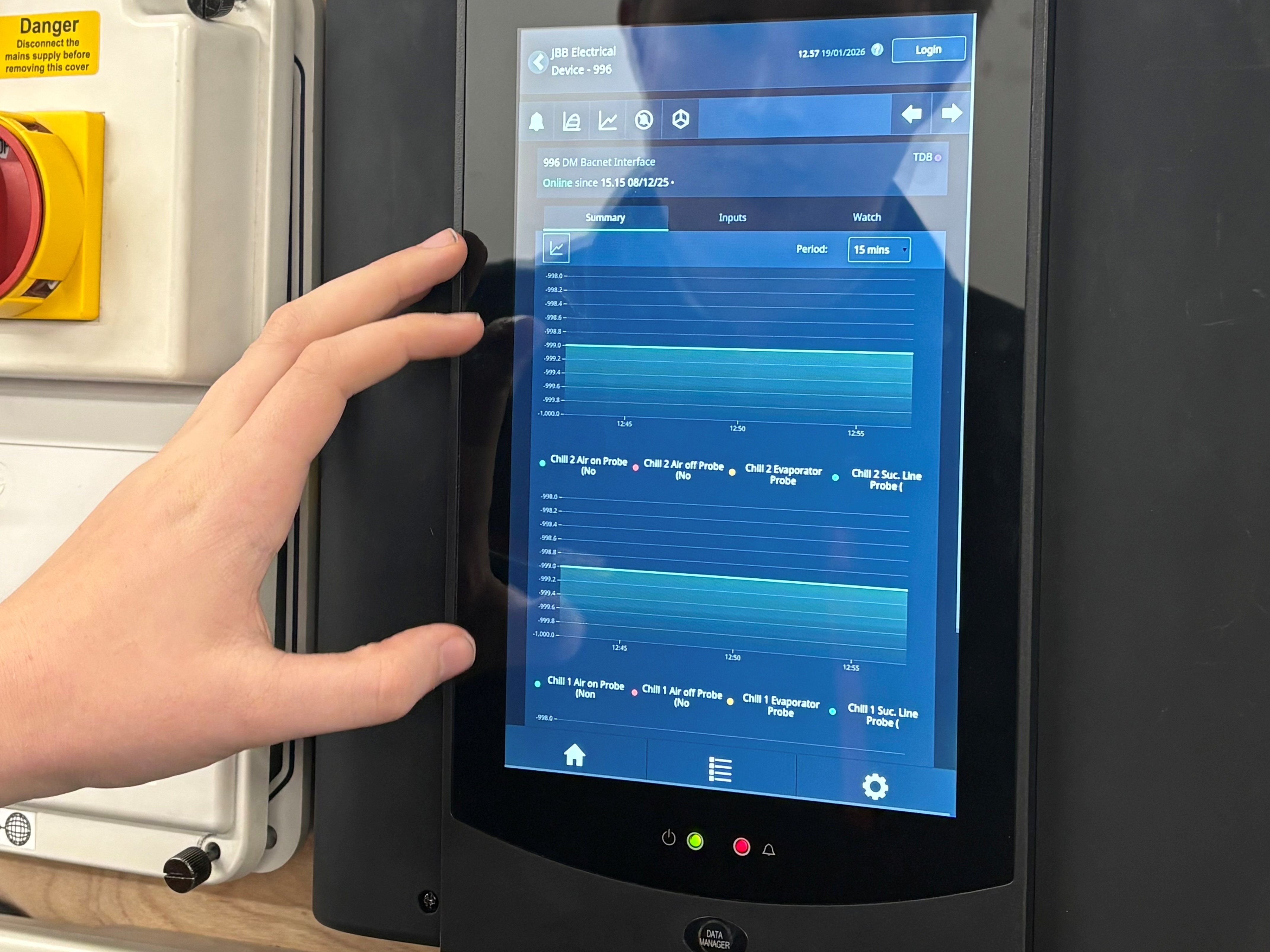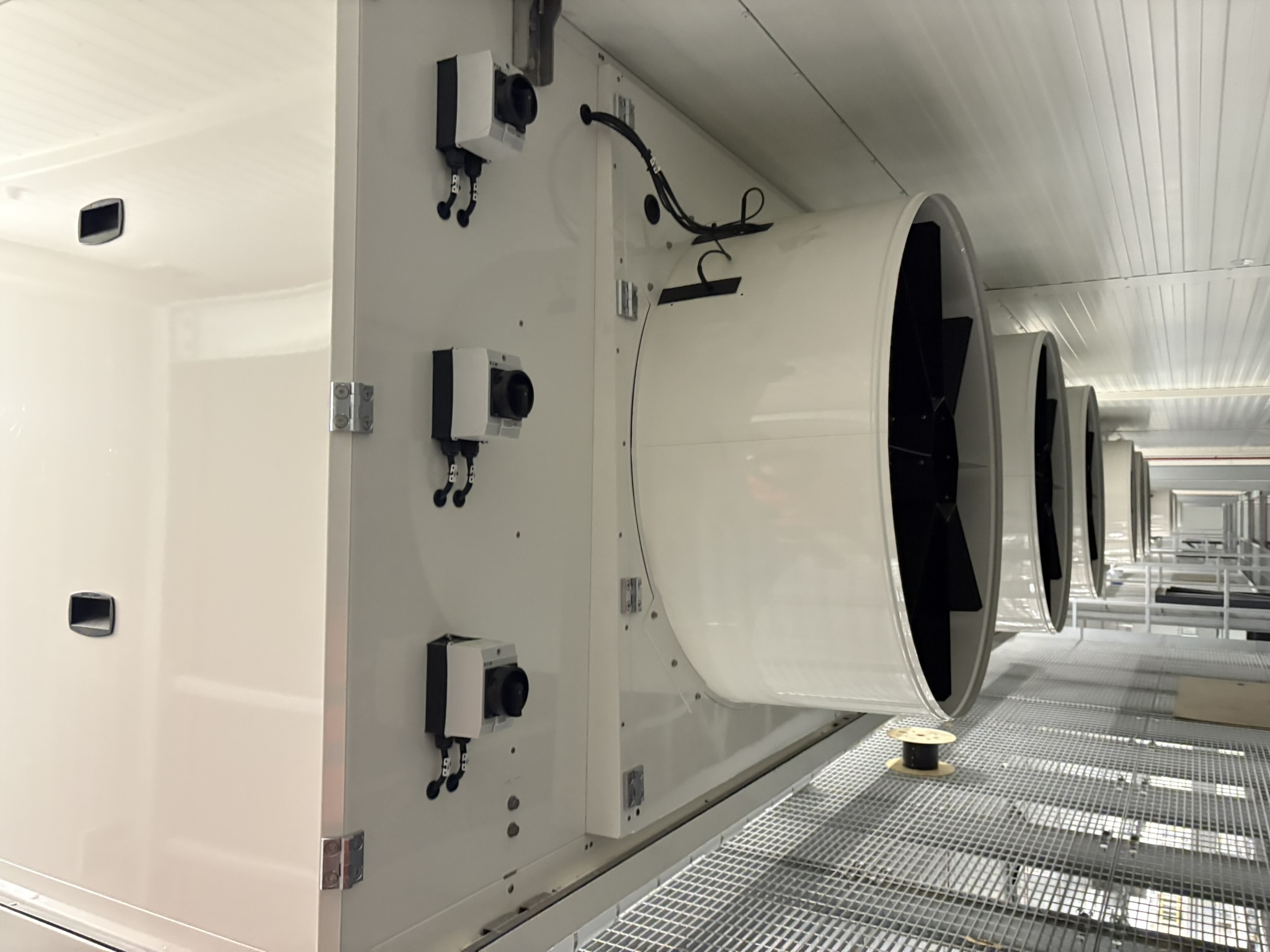
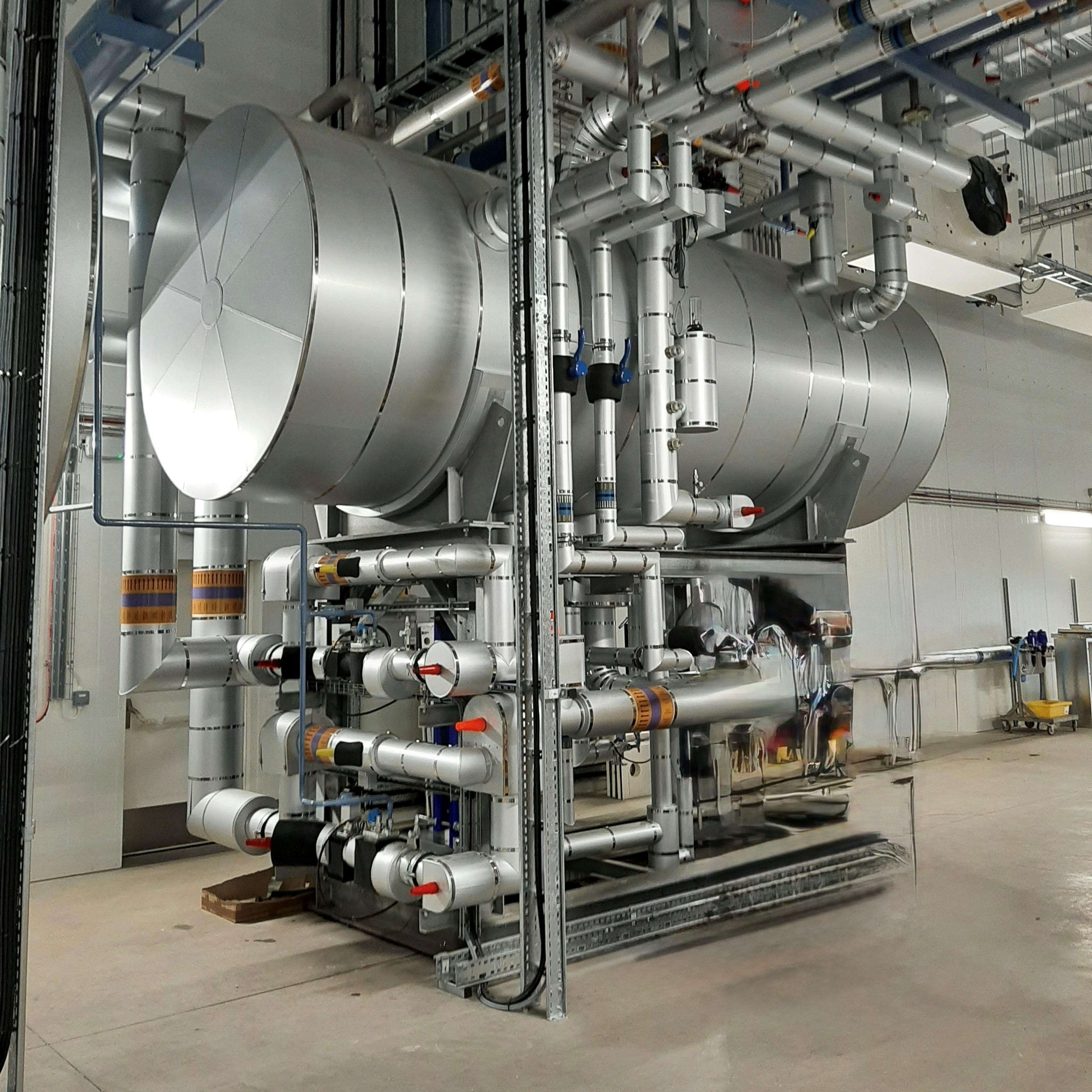
A refrigeration system that is cooling product, holding setpoint, and showing no active alarms looks healthy. In operational terms, it passes every visible check.
The problem is that apparent operation and genuine reliability are not the same thing. Refrigeration system installation quality, control logic integrity, and alarm configuration all determine whether a system will continue to function under real-world conditions - not just whether it is functioning right now. The conditions for failure can exist for months before a fault surfaces as a production incident.
The Gap Between 'Running' and 'Reliable': Why Apparent Operation Isn't Enough
Most unplanned refrigeration failures are not sudden events. They are the end point of a degradation process that was already underway during normal operation.
A system can hold setpoint temperature while simultaneously having degraded protection schemes, misconfigured alarms, or intermittent sensor drift - none of which trigger visible faults. The control panel continues to signal normal status. Operators see nothing to investigate. The degradation continues.
This false confidence is the core risk. It is not that facilities managers are careless - it is that the system is not designed to surface these failure conditions automatically. Identifying them requires active diagnostic work that goes beyond reading a temperature display or checking an alarm log.
The diagnostic gap
A refrigeration system can appear fully operational - holding product temperature, running compressors, logging no faults - while carrying protection relay settings that no longer match installed load, alarm thresholds that have drifted from commissioning values, and PLC logic that has been informally edited and never re-documented. None of these conditions generate alarms. All of them create downtime risk.
Control System Issues That Create Downtime Without Triggering Alarms
The most dangerous fault categories are those that do not announce themselves. Three mechanisms are particularly common in refrigeration control systems that have been in service for several years.
Alarm threshold drift is the first. During commissioning, alarm setpoints are configured to suit the conditions at the time - ambient temperature, product load, and compressor capacity. As the system ages or the load profile changes, those thresholds may no longer match operational reality.
Thresholds set too wide fail to detect early deterioration. Thresholds set too narrow generate nuisance trips that operators learn to acknowledge and dismiss without investigation. Both outcomes reduce genuine protection - and neither generates a fault code that identifies the problem.
Temperature sensor drift is the second mechanism. A probe that is reading consistently within operational tolerance - say, plus or minus one degree from setpoint - can still be reading inaccurately enough to cause compliance failure or product loss. If that drift falls within the alarm band, the system will not flag it. Only calibration to UKAS traceable standards will identify whether sensors are reading true.
Protection relay misconfiguration is the third. Protection settings that were correct at installation can become misaligned when motors are replaced, compressor stages are added, or the power supply characteristics change. A relay that does not trip under fault conditions is not protecting the system - it is providing false assurance.
Three silent failure mechanisms
Alarm threshold drift, temperature sensor drift, and protection relay misconfiguration share a defining characteristic: none generates a fault code during normal operation. A system carrying all three can hold setpoint and log no alarms while simultaneously failing to detect early compressor deterioration, reporting inaccurate temperatures, and operating with protection that will not trip under a genuine fault condition. The failure mode only becomes visible when the conditions for failure are already advanced.
How Poor Installation Decisions Create Long-Term Vulnerability
Installation quality determines how a system behaves under sustained operational stress - not just at the point of commissioning.
Refrigeration system installation deficiencies often originate at the control panel. Undersized cable runs, terminal connections torqued to incorrect values, and inadequate segregation between power and signal wiring all create conditions that degrade gradually. A loose busbar connection in the motor control centre may carry full load for months before the resistance-induced heat causes insulation breakdown.
Illustrative scenario - representative of the engineering pattern, not a documented JBB project
Motor Control Centre (MCC) serving a cold storage compressor bank - a busbar connection running significantly above reference temperature during a thermal imaging survey. Engineering action: retorque the connection during a planned maintenance window and re-survey to confirm temperature normalisation. Consequence avoided: left unaddressed, the connection would progress to insulation failure and compressor loss - presenting as an unexplained trip under peak load conditions with no prior alarm indication.
Documentation failures compound installation problems. When control panel wiring does not match the as-built drawings, or when commissioning records are incomplete, maintenance engineers are working blind. The next engineer to modify or fault-find the system cannot rely on the documentation - and incorrect assumptions during fault diagnosis can introduce additional errors.
A properly engineered refrigeration control panel installation - including Control Panels & MCC Design that is built to documented schematics and tested against defined acceptance criteria - gives the system a traceable baseline. That baseline is what makes future assessments meaningful.
Undersized cable runs and incorrectly torqued terminal connections create sustained thermal stress that degrades insulation gradually rather than triggering an immediate fault. Signal wiring routed alongside power cables introduces interference into sensor readings, compounding the effect of protection relay settings that were never verified against installed load. Without complete commissioning documentation, the engineer diagnosing the resulting fault has no reliable baseline — and incorrect assumptions made during fault-finding introduce further errors into a system that was already compromised at the point of installation.
The Role of Control Logic in Silent System Degradation
PLC control logic is where many refrigeration systems accumulate invisible risk over time.
Logic that was configured correctly at commissioning can be modified informally - to address a nuisance alarm, adapt to a new product line, or work around a component failure that was never properly resolved. These changes are often made without version control, without updated documentation, and without testing under the full range of operating conditions.
The result is PLC logic that behaves unpredictably under load changes or setpoint adjustments - not because the hardware has failed, but because the control structure no longer matches the system it was designed to govern. The system runs normally under stable conditions. Under a defrost cycle, a load change, or a setpoint shift, the undocumented logic produces unexpected behaviour.
Undocumented PLC modifications
An informally modified PLC program with no version history cannot be safely fault-diagnosed, maintained, or expanded. If the engineer who made the change is no longer available, there is no reliable way to determine what the logic is doing - or why. This is a common source of intermittent refrigeration faults that resist straightforward diagnosis.
PLC & Software Development work - including structured code review against the original program specification - is the only reliable way to identify whether the control logic governing a refrigeration system reflects documented design intent or has accumulated informal changes that create latent risk.
What a Proper Refrigeration Control Assessment Should Cover
A structured assessment of a refrigeration control system covers more than checking temperatures and reviewing the alarm log. The following areas represent the minimum scope for a defensible assessment.
- Thermal imaging of the control panel and MCC - to identify connection faults, overloaded conductors, and component degradation not visible during normal inspection
- Protection relay settings review - to verify that trip thresholds match installed load and that discrimination between protection levels is maintained
- Alarm configuration audit - to confirm thresholds are correctly set, that alarm handling procedures are current, and that nuisance trip patterns are investigated rather than suppressed
- PLC program version audit - to verify the installed logic matches the documented version, and identify any undocumented modifications
- Temperature sensor calibration verification - to UKAS traceable standards, confirming sensor accuracy is within specification and that drift is within acceptable limits for compliance purposes
- BS 7671 installation compliance check - to confirm wiring, protective devices, and earthing arrangements remain compliant with current regulations
- Critical spares review - to confirm that contactors, relays, HMI components, and other high-risk items are held on site or within short procurement lead times
Each of these checks addresses a specific failure pathway. Together, they replace false confidence based on apparent operation with verified confidence based on measured system condition.
Critical spares planning
Strategic spares planning for refrigeration control components - particularly contactors, relays, and HMI screens - directly reduces mean time to recovery when a latent fault finally presents as a failure. An unplanned stoppage that takes days to resolve because a contactor is on a three-week lead time is not a supply chain problem. It is a consequence of not having assessed spares risk in advance.
The JBB Refrigeration Control System Methodology
The JBB Refrigeration Control System Methodology
Assess
JBB Electrical conducts a structured Compliance & Breakdown Prevention Assessment covering thermal imaging of the control panel and MCC, protection relay settings, alarm threshold configuration, PLC program version against installation documentation, and BS 7671 compliance — establishing verified system condition rather than assumed health.
Modernise
Where assessment identifies undocumented PLC logic modifications, outdated control panel wiring, or protection schemes that no longer match installed load, JBB engineers update, re-document, and re-test the affected control systems using EPLAN Electric P8 for schematic accuracy and structured PLC code review — restoring a reliable, auditable baseline.
Protect
JBB implements verified protection relay settings, correctly configured alarm thresholds, and UKAS traceable temperature sensor calibration to ensure the refrigeration control system detects genuine fault conditions without generating nuisance trips that operators learn to dismiss.
Prevent
Preventive Electrical Maintenance programmes — including scheduled thermal imaging surveys, protection testing, and PLC program audits — are structured around the specific failure modes identified during assessment, so deteriorating connections, drifting sensors, and logic anomalies are caught before they progress to unplanned downtime.
Support
JBB Electrical provides ongoing Refrigeration Control Systems support including critical spares management, PLC configuration backups, and defined response protocols — so recovery is measured in hours rather than days when a latent fault finally presents.
From Reactive to Predictive: Closing the Gap Before a Failure Occurs
The shift from reactive to predictive is not a technology question. It is a diagnostic discipline question.
Facilities that experience repeated unplanned refrigeration downtime are not unlucky. They are operating systems whose control infrastructure has not been systematically assessed against the conditions that cause failure. The failure events that appear sudden are the product of degradation that was already measurable - in thermal signatures, in relay settings, in alarm patterns, in sensor drift.
Diagnostic discipline, not diagnostic technology
The shift from reactive to predictive does not require new monitoring hardware. It requires a structured assessment that replaces assumed system health with measured system condition — thermal imaging of the control panel, protection relay verification, PLC program audit, and UKAS traceable sensor calibration. Each of these checks is available now, on any existing refrigeration control system. The question is whether they have been carried out against current operating conditions, and whether the results are documented.
JBB Electrical has designed, installed, and assessed refrigeration control systems across food processing, cold storage, and pharmaceutical facilities since Founded 1966. As an NICEIC-approved contractor, our assessments produce a prioritised action plan - not a general report - that identifies exactly which control system conditions require intervention and in what sequence.
The same team handles design, build, test, and documentation - eliminating the accountability gaps that arise when these stages are divided between different contractors. That continuity matters when diagnosing a system whose installation history is incomplete or whose documentation does not reflect current configuration.
The right question to ask
The question is not whether your refrigeration system is running. It is whether your control system's protection schemes, alarm configurations, PLC logic, and sensor calibration are verified against current operating conditions. If any of those four cannot be confirmed with documented evidence, you are carrying unquantified downtime risk.
Next Step: Request a Compliance & Breakdown Prevention Assessment
Next Step: Request a Compliance & Breakdown Prevention Assessment
A Compliance & Breakdown Prevention Assessment identifies the electrical, compliance, and breakdown risks affecting your operation, and sets out the engineering actions needed to reduce downtime, protect reliability, and keep your infrastructure defensibly compliant. Request a Compliance & Breakdown Prevention Assessment today to identify the control system faults and installation deficiencies creating downtime risk in your refrigeration system before they surface as a production failure.
Compliance & Breakdown Prevention Assessment