
Selecting industrial control panel manufacturers UK-wide on price and lead time alone is one of the most reliable ways to create expensive problems post-installation. The documentation gaps, compliance shortfalls, and expansion constraints that surface six months after commissioning were almost always present in the original submission - the tender process simply was not designed to find them.
This is not a supplier honesty problem. It is a structural problem with how most tender evaluation frameworks are built. The criteria that dominate most scorecards - price, delivery date, basic certification - are necessary but nowhere near sufficient. The engineering decisions that determine whether a panel is reliable, maintainable, and expansion-ready are largely invisible in a price-only evaluation.
Why Low-Price Tenders Consistently Produce High-Cost Outcomes
The lowest tender price rarely represents the lowest total cost of ownership. What it usually represents is a set of unstated assumptions - about documentation depth, component grade, testing rigour, and future expansion provision - that the buyer has not asked about and the supplier has not volunteered.
A manufacturer pricing competitively may source components to a budget, omit detailed schematics from the deliverables package, or build a panel that meets a basic inspection without fully satisfying the long-term intent of BS EN 60204-1. None of this is deceptive. It is a rational response to a specification that did not require anything different.
The operational consequences arrive later. A maintenance engineer working on a panel without accurate as-built drawings is operating blind - every intervention takes longer, carries more risk, and creates more potential for error. An insurance inspector who cannot find current testing certificates will flag the gap. A production team that needs to add a new machine line discovers the panel has no spare capacity and no logical feed points.
The core problem with price-led evaluation
The costs of inadequate documentation, marginal compliance, and absent expansion provision do not appear in the tender comparison. They appear in the maintenance budget, insurance audit findings, and capital expenditure plan - often years later, when the connection to the original procurement decision is no longer obvious.
The Six Evaluation Criteria Most Tenders Get Wrong
Most tender scorecards weight the following criteria heavily: price, delivery schedule, basic certification, company size, previous project references, and warranty terms. These are not wrong criteria - they are incomplete ones. They measure what a supplier has done, not how they engineer.
The six criteria that consistently go underweighted or absent are:
- Schematic design deliverables - whether full as-built drawings are a contracted output, not an optional extra
- Component specification transparency - the actual make and grade of protection devices, contactors, and PLCs, not just a generic bill of materials
- BS EN 60204-1 compliance depth - whether the panel satisfies the standard's intent or merely passes a basic visual inspection
- Future expansion provision - whether spare ways, cable entries, and logical feed points are designed in from the outset
- Testing protocol documentation - whether factory acceptance test records and commissioning certificates are specified deliverables
- Engineering process visibility - whether the buyer can assess how the panel is designed, not just the finished product
Each of these gaps has a predictable operational consequence. The section below addresses the compliance question specifically, because it is where the most significant misconceptions tend to sit.
What a Compliant Control Panel Specification Actually Requires
BS EN 60204-1 compliance is not binary. A panel can pass a basic inspection while still containing design decisions that create long-term safety constraints or make future modification unnecessarily difficult. Understanding what compliance actually requires - as opposed to what a basic check confirms - is one of the most practically valuable things a buyer can develop.
What 'compliant' does not guarantee
A panel that passes a basic BS EN 60204-1 inspection may still contain protection devices selected for cost rather than discrimination characteristics, control circuits that create ambiguity during fault diagnosis, and documentation that does not support third-party maintenance. Compliance status confirms a threshold was reached. It does not confirm which engineering decisions were made to reach it.
The standard covers safety of machinery in the context of electrical equipment. It specifies requirements for protection against electric shock, control circuit design, fault detection, emergency stop function, and documentation. A panel that meets the standard correctly should have protection schemes that are co-ordinated, interlocks that are verified, and documentation that is complete enough for a third-party engineer to work on it safely.
Where panels fall short, it is typically in the details: protection devices selected for cost rather than discrimination characteristics, control wiring that meets the letter of the standard but creates ambiguity during fault diagnosis, or emergency stop circuits that function correctly in normal operation but have not been validated under fault conditions. BS 7671 requirements for the incoming supply and earthing arrangements add a further compliance dimension that not all panel manufacturers address with equal rigour.
Where BS 7671 adds a further compliance dimension
BS 7671 requirements for the incoming supply, protective earthing, and fault loop impedance sit alongside BS EN 60204-1 - not inside it. Not all panel manufacturers address both standards with equal rigour. A tender specification that references only one creates an unexamined gap in the other.
Compliance margin vs. compliance intent
A tender specification that asks only for 'BS EN 60204-1 compliant' without defining the depth of compliance evidence required will routinely receive panels that meet the minimum threshold. Specifying the required documentation outputs - protection co-ordination studies, test records, wiring schedules - raises the bar in ways that compliance certification alone does not.
Documentation and Testing: The Deliverables That Determine Long-Term Risk
Post-installation testing certificates and as-built drawings are not optional extras. They are legal and insurance requirements - and they must be specified as contracted deliverables in the tender, not requested as an afterthought at handover.
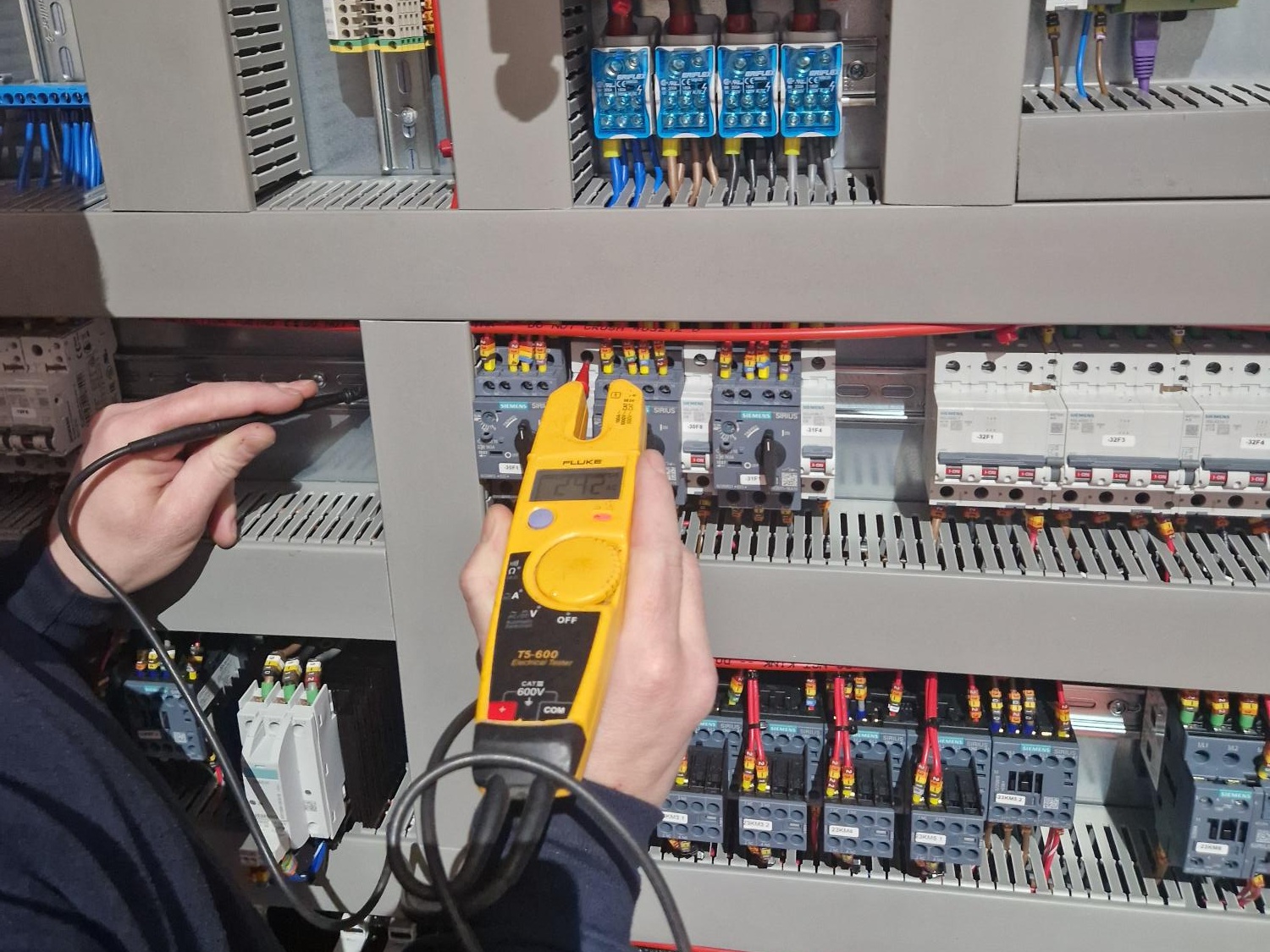
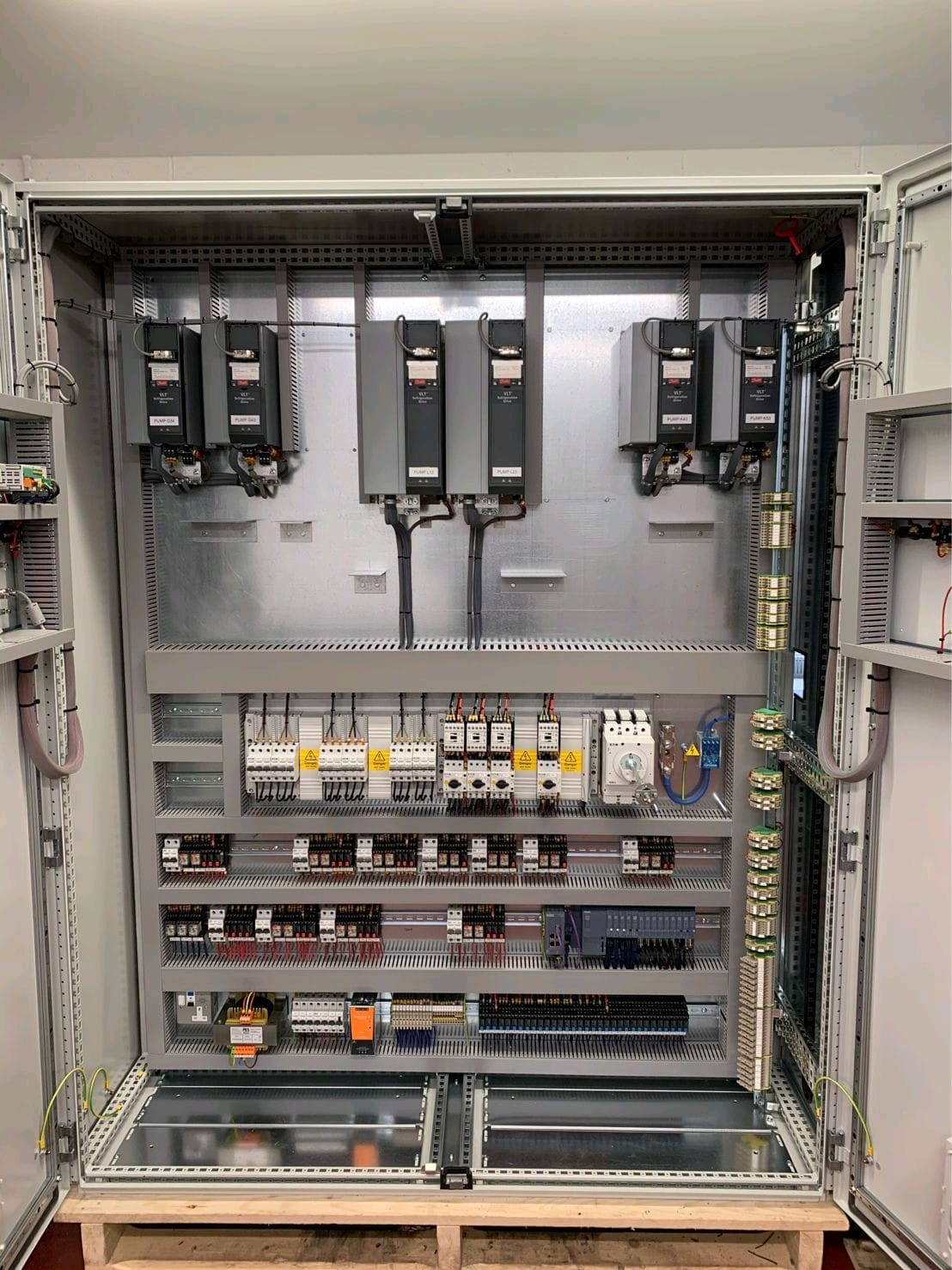
The documentation package that should accompany every industrial control panel includes: full as-built schematics reflecting what was actually built (not the design intent), factory acceptance test records, installation and commissioning certificates, operation and maintenance manuals, and a component schedule with model numbers and settings. Without this package, every future maintenance intervention starts from a less informed position.
Illustrative example - representative of the engineering pattern, not a documented JBB project
Consider a food manufacturing site where an ageing motor control centre is replaced following a competitive tender. The winning submission is priced competitively and delivered on time. Eighteen months later, a maintenance engineer needs to trace a recurring fault on a conveyor drive. The schematic supplied at handover reflects the original design rather than the as-built configuration - two circuit modifications made during commissioning were never captured. The fault diagnosis takes significantly longer than it should. An insurance inspection the following quarter flags the discrepancy between the supplied documentation and the installed panel, requiring a full survey to close the gap. The equipment type is a motor control centre. The finding is absent or inaccurate as-built documentation. The correct engineering response is to specify as-built drawing updates as a contractual deliverable with a defined submission deadline. The consequence avoided is extended fault diagnosis time and insurance audit exposure.
Testing rigour is equally important to specify. A factory acceptance test conducted to a defined protocol - with recorded results against pass/fail criteria - is a different deliverable to a manufacturer's informal sign-off before despatch. The distinction matters when a fault surfaces post-installation and the question of whether it was present at build or introduced during installation needs to be answered.
How to Assess a Control Panel Manufacturer's Engineering Capability - Not Just Their Quote
Evaluating the engineering process behind a quote is more reliably predictive of long-term panel performance than evaluating the quote itself. A manufacturer with strong in-house capability - schematic design, component sourcing, assembly, testing, and documentation under one roof - eliminates the accountability gaps that arise when these activities are split across different contractors.
The questions that surface engineering capability are operational, not commercial. Ask a prospective manufacturer how they handle component obsolescence planning for PLCs - whether that is Siemens, Allen-Bradley, or RDM platforms. Ask what their process is when a component specified at design stage becomes unavailable between order and build. Ask how they document and communicate mid-build changes. Ask what their factory acceptance test protocol covers and how results are recorded. These questions do not require a site visit to answer - but the quality and specificity of the responses will tell you a great deal.
Questions that reveal engineering process quality
Ask to see a sample documentation package from a completed project - schematics, test records, and component schedule. A manufacturer with genuine in-house capability will have these readily available and structured consistently. A manufacturer assembling to others' designs may not.
In-house manufacturing capability also affects how expansion requirements are handled. A panel built with no spare capacity - cable ways at full capacity, no spare MCB ways, no logical provision for additional drives - forces complete rewiring when production requirements change. This risk is invisible in a price-only evaluation but straightforward to test for: ask the manufacturer to describe how they have provisioned for the expansion scenarios outlined in the specification.
The JBB Control Panel Tender Evaluation Methodology
The JBB Control Panel Tender Evaluation Methodology
Assess
Review the existing tender specification against BS EN 60204-1 and BS 7671 requirements, identifying gaps in defined deliverables - particularly schematic design outputs, testing protocols, and expansion provision - before issuing to market.
Modernise
Reframe the specification to require full as-built documentation, factory acceptance test records, and component schedules as contracted deliverables, using EPLAN Electric P8 schematic standards where applicable to ensure drawings are structured for long-term maintainability.
Protect
Evaluate each submission against the engineering process criteria - in-house manufacturing capability, protection co-ordination approach, component grade and obsolescence planning for Siemens, Allen-Bradley, or RDM platforms - not price and lead time alone.
Prevent
Specify testing and commissioning protocols that require recorded results against defined pass/fail criteria, ensuring future fault diagnosis and insurance inspections can be supported by complete, accurate documentation that reflects the as-built panel configuration.
Support
As a NICEIC-approved contractor with in-house manufacturing capability and over five decades of continuous industrial electrical contracting since our founding in 1966, JBB Electrical provides ongoing support - from periodic compliance assessments and thermal imaging surveys through to critical spares planning and documentation updates - ensuring the panel continues to perform within specification throughout its operational life.
This methodology applies whether you are tendering a new panel build or evaluating a replacement for ageing infrastructure. The same structural gaps appear in both contexts - and the same questions surface them.
Building a Tender Framework That Protects Operations, Not Just Budget
A tender framework that protects long-term operational integrity starts with the specification, not the evaluation scorecard. The scorecard can only assess what the specification requires. If documentation deliverables, compliance depth, testing protocols, and expansion provision are absent from the specification, no scoring system will surface them.
The practical steps are straightforward, even if they require upfront investment in specification quality:
- Define documentation deliverables explicitly: full as-built schematics, component schedules with model numbers, factory acceptance test records, and commissioning certificates - all as contracted outputs with submission deadlines
- Specify compliance depth, not just compliance status: require evidence of protection co-ordination, emergency stop validation, and earthing verification in line with BS EN 60204-1 and BS 7671
- Include expansion requirements as a specification input: define the production scenarios the panel must accommodate within its operational life and ask manufacturers to demonstrate how they have provisioned for them
- Add engineering process questions to the evaluation: how component substitutions are managed, how documentation is kept current during build, and what the factory acceptance test protocol covers
- Weight documentation and testing compliance in the scorecard: not just price, delivery, and certification
Scoring documentation and testing in the evaluation
A scorecard that weights documentation deliverables and testing protocol compliance alongside price and delivery reflects the full cost of ownership - not just the build cost. Manufacturers who invest in EPLAN Electric P8 schematic design and rigorous factory acceptance testing are structured to score well when these criteria are present. A price-only scorecard actively disadvantages them.
This is the kind of specification discipline that separates a Control Panel Design & Manufacture engagement that performs well over ten years from one that creates avoidable costs within eighteen months. JBB Electrical's structured approach - same team across design, build, test, and documentation, eliminating the accountability gaps that arise when these activities are divided - is built precisely to satisfy specifications constructed this way.
What strong specifications attract
A well-constructed specification does more than protect the buyer - it attracts manufacturers whose process can genuinely satisfy it. Manufacturers who invest in EPLAN Electric P8 schematic design, rigorous factory acceptance testing, and complete documentation packages are structured to respond to specifications that require these things. A price-only evaluation actively disadvantages them.
The operational exposure created by a structurally weak tender process is rarely visible at the point of selection. It surfaces at the first maintenance intervention, the first insurance inspection, and the first time production requirements change. Addressing the evaluation framework before issuing to market is the lower-cost option - and a straightforward problem to fix once the right questions are identified.
Next Step: Request a Compliance & Breakdown Prevention Assessment
Next Step: Request a Compliance & Breakdown Prevention Assessment
A Compliance & Breakdown Prevention Assessment identifies the electrical, compliance, and breakdown risks affecting your operation, and sets out the engineering actions needed to reduce downtime, protect reliability, and keep your infrastructure defensibly compliant. Request a Compliance & Breakdown Prevention Assessment today to ensure your next control panel tender specification captures the documentation, compliance, and engineering process requirements that protect your operation long after installation.
Compliance & Breakdown Prevention Assessment