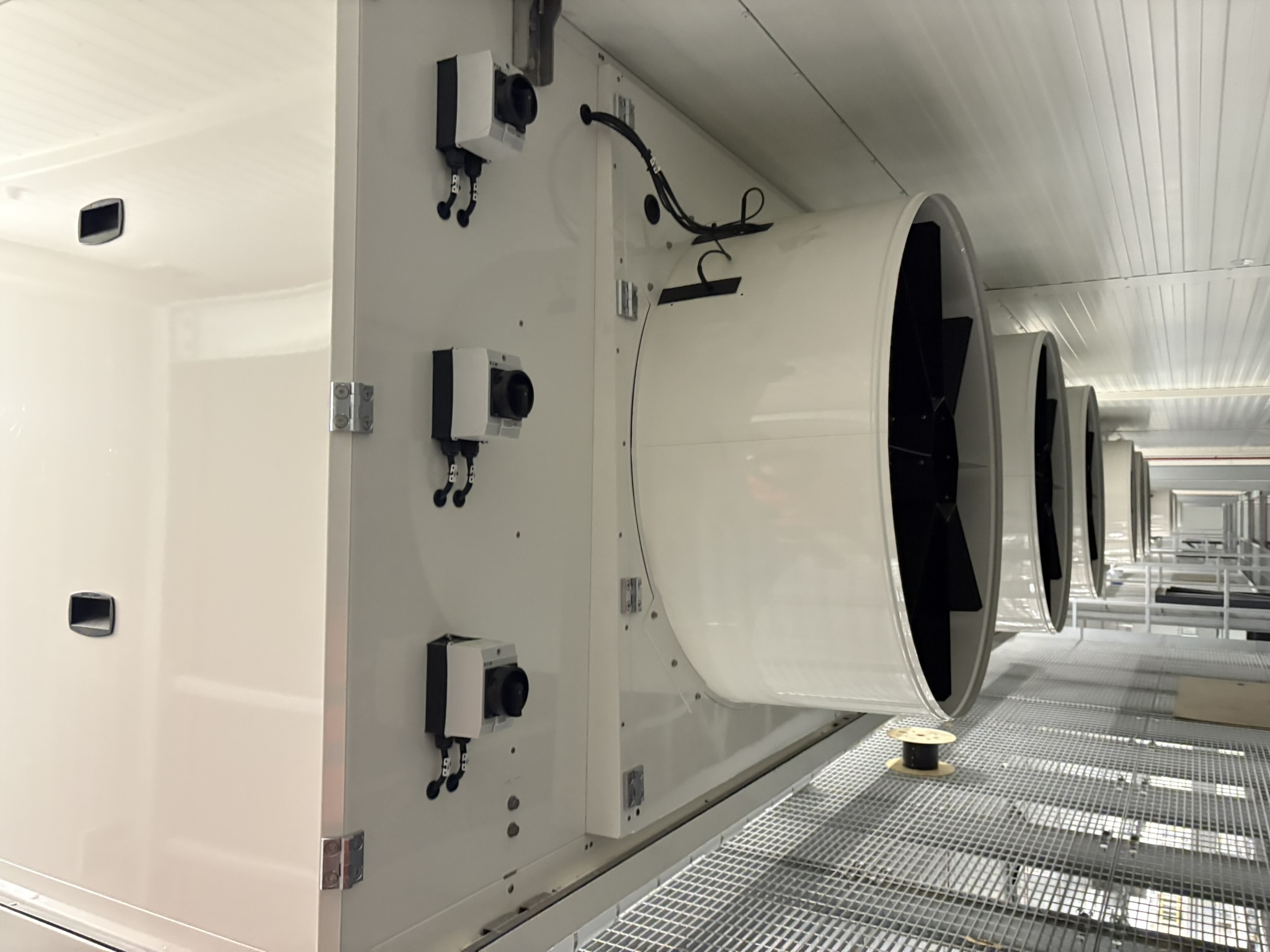

Specifying a control panel for refrigerator plant in a food processing facility is a fundamentally different engineering problem from standard industrial panel design. The enclosure will be exposed to wash-down water, chemical cleaning agents, and condensation cycles. The control logic must satisfy food safety auditors, not just operators. And the documentation the panel generates - alarm logs, temperature records, calibration certificates - becomes evidence in regulatory inspections.
This guide sets out the specification decisions that determine whether a refrigeration control panel is genuinely fit for purpose in a food processing environment - from enclosure selection through to future-proofing for refrigerant transitions.
Why Food Processing Environments Set a Higher Bar for Refrigeration Panel Specification
The failure modes that matter in food processing are not the same as those in a dry industrial environment. Ingress of water and cleaning chemicals causes premature component failure, arc faults, and insulation breakdown. Condensation on cold surfaces creates leakage paths across control circuit boards. And any panel that fails hygiene inspection - regardless of its electrical performance - becomes a production liability.
The consequence of under-specifying the enclosure is not just a failed audit. It is reactive replacement of panels that were inadequate from day one, with all the downtime and remediation cost that entails. The specification must be correct before manufacture begins.
Specification is a design decision, not a procurement one
Enclosure grade, material finish, cable management approach, and monitoring integration must be locked at the design stage. Retrofitting IP-rated glands or temperature inputs into a panel already manufactured to a lower standard is costly and rarely produces an equivalent result.
Enclosure Standards: IP Ratings, Materials, and Hygienic Cable Management
IP rating selection depends on the specific zone the panel occupies, not a blanket figure applied across the facility. The three grades most relevant to food processing are IP54, IP65, and IP66 - and the differences are operationally significant.
- IP54 - dust protection and splash resistance. Acceptable only in dry goods storage or plant rooms where direct wash-down does not occur and ambient humidity is controlled.
- IP65 - dust-tight and low-pressure water jet resistance. The minimum specification for most production floor and cold store environments where periodic wash-down is conducted.
- IP66 - dust-tight and high-pressure water jet resistance. Required in wet processing areas, blast freeze tunnels, and any zone where high-pressure hose cleaning is routine.
Specifying IP65 across a facility that includes IP66-rated wash-down zones creates a compliance gap. Zone-by-zone assessment of cleaning regimes and ambient conditions must drive the enclosure grade, not a facility-wide default.
Zone-by-zone IP assessment is mandatory
A single IP rating applied across the entire facility will either over-specify low-risk areas or leave high-risk zones inadequately protected. Map each panel location against its cleaning regime — water pressure, chemical type, and frequency — and specify the enclosure grade for each zone independently. Document that assessment: auditors who challenge enclosure selection are satisfied by a zone-by-zone justification, not a facility-wide default.
Enclosure Material Selection
Stainless steel - typically grade 304 as a minimum, 316 in chlorine-heavy environments - is the correct material for enclosures in production and processing zones. It withstands chemical cleaning agents, does not harbour bacteria in surface imperfections, and maintains structural integrity under repeated thermal cycling.
Powder-coated mild steel is acceptable in plant rooms and dry utility areas where the panel is not directly exposed to cleaning chemicals or condensation. It should not be specified for cold store interiors or production areas where surface integrity will be compromised within the first maintenance cycle.
Hygienic Cable Management
Cable management in food processing environments must eliminate harbourage points - surfaces where organic matter, moisture, or cleaning chemical residue can accumulate and support microbial growth. Three specification principles apply:
- Eliminate horizontal ledges. Cable trunking must be specified with closed tops or angled covers. Open-top trunking running horizontally along panel bases or cable routes creates accumulation points that cannot be adequately cleaned.
- Specify conduit for exposed runs. Where cables exit the enclosure into production areas, fully enclosed conduit systems rated for the cleaning regime protect both the cable and the hygiene zone. Flexible conduit joints must be sealed against ingress.
- Seal all penetrations. Cable entry glands must be IP-rated to match the enclosure grade and sealed with appropriate compounds. Unsealed glands in a stainless steel IP66 enclosure reduce the assembly to the ingress protection of the weakest penetration.
Integrating Temperature Monitoring and Alarm Outputs at the Design Stage
Temperature monitoring inputs should be designed into the panel architecture, not wired in after the panel is installed. Retrofitting thermocouple or RTD inputs to a panel that was not specified with them creates documentation gaps, introduces cable management compromises, and frequently results in inputs that are not captured in the panel's as-built schematics.
The three sensor types in common use each have different wiring requirements at the panel:
- Thermocouples require compensating cable matched to the thermocouple type (J, K, T) throughout the circuit. Any junction to standard copper introduces a measurement error. Panel terminal blocks must be thermocouple-rated.
- RTDs (Pt100/Pt1000) require three or four-wire connections to eliminate lead resistance error. Two-wire RTD circuits introduce an offset proportional to cable length - unacceptable where critical temperature thresholds determine product safety decisions.
- Digital probes (NTC/digital output) are simpler to terminate but require the panel's PLC or controller to be programmed with the correct linearisation curve and communication protocol at the design stage.
Thermocouple compensating cable is not optional
Any junction between thermocouple extension cable and standard copper conductor introduces a parasitic EMF that the measurement system reads as a temperature offset. In a cold store application where a 1°C measurement error could place a product temperature record on the wrong side of a safety threshold, this is a compliance risk, not merely an accuracy concern. Specify thermocouple-rated terminal blocks throughout, and confirm compensating cable type matches the thermocouple grade (J, K, or T) on every circuit.
Alarm Output Architecture
Alarm output design directly affects audit compliance. A panel that triggers an audible alarm but does not log the event, timestamp it, and store it in a retrievable format fails the evidential requirement of BRC and SALSA inspections.
The alarm architecture should include: local audible and visual indication at the panel for immediate operator response; volt-free contacts for remote telemetry to a building management system or standalone monitoring unit; and event logging within the PLC or SCADA system capturing the alarm type, timestamp, setpoint exceedance magnitude, and acknowledgement record.
Illustrative scenario - representative of JBB project work
Cold store distribution board, food manufacturing facility. Temperature monitoring inputs were not included in the original panel specification. Audit preparation identified that alarm events were being captured only by a standalone data logger with no integration into the panel documentation. An engineer reviewing the installation would specify four Pt100 RTD inputs added to the PLC I/O rack, with alarm event logging routed through SCADA and timestamped records stored to a network drive accessible to the quality team. The operational consequence avoided: temperature exceedance events captured without a linked alarm log would not satisfy BRC traceability requirements - the data existed, but could not be presented as a defensible audit trail.
Defrost Cycle Automation, Setpoint Control, and SCADA Data Logging for Compliance
Defrost cycle control is one of the more complex logic sequences in a refrigeration panel, and its specification has direct compliance implications. The panel must manage defrost initiation (time-based or sensor-initiated), termination (by temperature threshold or elapsed time), and drip-down timers that prevent compressor restart before drain-off is complete.
Each defrost cycle event - start time, termination trigger, duration, and any alarm generated during the cycle - must be logged. Auditors reviewing BRC compliance look for evidence that defrost cycles are operating as designed and that product temperatures remain within safe limits throughout the process. A panel that runs defrost correctly but produces no logged record of it cannot satisfy that evidential requirement.
Defrost cycle logs are audit evidence, not operational data
BRC and SALSA auditors reviewing cold store compliance will expect to see defrost cycle records alongside temperature logs — because product temperature during a poorly terminated defrost cycle is a food safety variable, not just a maintenance concern. A panel that executes defrost correctly but produces no timestamped record of initiation, termination trigger, and duration cannot demonstrate that the cycle operated as designed. Specify defrost event logging as a named deliverable in the panel design brief, not as a commissioning afterthought.
Setpoint Adjustment and Access Control
Setpoint adjustment controls carry a food safety implication that is often overlooked at the specification stage. If temperature setpoints can be changed by any operator without a logged record of who changed them and when, the audit trail is broken. The specification must define who has access and what is recorded.
- Local HMI setpoint adjustment should be access-controlled by password or key-switch. Any setpoint change must generate a timestamped event log entry capturing the previous value, the new value, and the user credential.
- SCADA-controlled setpoints provide superior audit trail capability because changes are inherently logged at the SCADA level with user authentication. This is the preferred architecture for BRC Grade AA facilities where change control evidence is mandatory.
SCADA data logging frequency
BRC Global Standard Issue 9 and SALSA audit requirements typically require temperature records at intervals sufficient to demonstrate continuous product safety - commonly every 15 minutes as a minimum for cold storage. Specify logging frequency at the design stage and configure the SCADA historian accordingly. A logging interval that cannot be changed without engineering access protects against inadvertent compliance gaps.
Documentation Requirements: What BRC, SALSA, and Food Safety Auditors Expect from Your Panel
The documentation a refrigeration control panel must support at audit goes beyond the standard electrical certification package. Food safety auditors are looking for evidence that the panel does what it was designed to do, that it has been maintained, and that its records are complete and retrievable.
The following documentation set must be specified as deliverables from the panel manufacturer and maintained throughout the panel's operational life:
Documentation is a specification deliverable, not a commissioning courtesy
The documentation set must be specified in the panel design brief as a named contractual deliverable — with the same precision as the enclosure grade or the PLC platform. Panels procured without explicit documentation requirements frequently arrive on site with incomplete as-built schematics, uncalibrated probes, and no version record for the PLC programme. By the time the audit arrives, the gap is expensive to close. Specify the documentation set at the design stage, and confirm its completeness before commissioning sign-off.
Refrigeration Panel Documentation for Food Safety Audit
- Wiring schematics and as-built drawings reflecting the installed configuration - not the original design if modifications have been made.
- BS EN 60204-1 and BS 7671 test certificates covering insulation resistance, earth continuity, and functional testing.
- Calibration records for all temperature monitoring inputs, with UKAS-traceable certification where required.
- Alarm event logs demonstrating that alarm conditions are captured with timestamps and acknowledgement records.
- Defrost cycle logs showing initiation, duration, and termination events.
- Maintenance schedules and service records - evidence that planned inspection and testing has been completed.
- PLC program documentation including version control records, so auditors can confirm the control logic matches the approved specification.
Calibration records deserve particular attention. Temperature probe calibration to UKAS-traceable standards - covering thermocouples, RTDs, and digital sensors - is the evidential link between what the panel displays and what the product actually experienced. Panels that rely on uncalibrated or out-of-date probes cannot produce defensible temperature records, regardless of how well the logging system performs.
As-built accuracy is a compliance risk
Modifications made to refrigeration panels after commissioning - additional inputs, alarm relay changes, setpoint logic updates - must be reflected in updated as-built schematics. Auditors who find that installed wiring does not match the schematic documentation have grounds to question the integrity of the entire documentation set. Every modification requires a drawing update.
The JBB Refrigeration Control Panel Specification Methodology
The JBB Refrigeration Control Panel Specification Methodology
Assess
We review the facility's zone-by-zone wash-down regimes, refrigerant type, cold store temperature profiles, and existing monitoring infrastructure to define the enclosure grade, material, IP rating, and control architecture required — before a single component is specified.
Modernise
Using EPLAN Electric P8, we design panel schematics that integrate Pt100 RTD or thermocouple inputs, SCADA data logging outputs, and defrost cycle logic into a coherent architecture — replacing ad-hoc, retrofitted monitoring arrangements with engineered, documented solutions.
Protect
As a NICEIC-approved contractor, we manufacture and test every panel to BS EN 60204-1 and BS 7671 requirements, specifying stainless steel enclosures and IP66 gland assemblies where the zone demands it, and delivering a complete test certificate and calibration documentation package before installation.
Prevent
We build spare PLC I/O capacity, modular busbar provisions, and documented code structure into every panel at manufacture — so that capacity expansion, refrigerant transition from R404A to R448A or CO2 cascade systems, and regulatory updates can be implemented without hardware replacement.
Support
JBB Electrical — delivering industrial electrical engineering since 1966 — provides a complete handover documentation set at commissioning: version-controlled PLC programme, UKAS-traceable probe calibration records, updated as-built EPLAN schematics, and alarm event logs structured to satisfy BRC and SALSA inspection from day one. Your panel is audit-ready from the commissioning date, not after the first inspection cycle.
Future-Proofing the Specification: Capacity Changes, Refrigerant Transitions, and Regulatory Updates
A refrigeration control panel specified only for current operating conditions is likely to require premature replacement. Three predictable changes should be accounted for in the original specification: capacity expansion, refrigerant transition, and regulatory updates to control logic.
Capacity Expansion
Specifying spare capacity is straightforward in principle but consistently omitted when panels are procured to minimum requirements. The specification should include:
Minimum-size enclosures create maximum replacement cost
An enclosure specified to the minimum dimensions for current requirements cannot accommodate additional components when the operation expands — and installing a second cabinet alongside an existing one is rarely straightforward in a food processing environment where wall space, hygiene zoning, and cable routes are constrained. Specify physical enclosure dimensions for the anticipated next increment, not the current load. The additional sheet metal cost at manufacture is a fraction of the replacement cost when expansion forces a new cabinet.
- Busbars rated and physically sized for the next anticipated load increment, not current load only.
- Modular PLC I/O racks with spare card slots populated or at minimum physically accommodated in the enclosure layout.
- Physical enclosure dimensions that allow additional components without a new cabinet - specifying the minimum-size enclosure for current requirements forces a full replacement when the operation expands.
Refrigerant Transition Planning
The transition away from high-GWP refrigerants is not a future possibility - it is a regulatory trajectory already in motion. Panels currently controlling R404A or R22 systems must eventually accommodate lower-GWP alternatives including R448A, R449A, or CO2 cascade configurations. Each transition changes operating pressures, sensor ranges, and in the case of CO2 systems, safety interlocks that must be designed into the control logic.
The panel specification should account for this by using PLC platforms with sufficient memory and I/O flexibility to accommodate updated control logic without hardware replacement, and by documenting the existing code in a modular structure that allows refrigerant-specific sections to be modified without rewriting the entire programme.
Modular PLC code structure reduces transition cost
A panel whose PLC code is structured as a monolithic programme - where refrigerant control logic is interwoven with defrost sequencing, alarm management, and SCADA communication - requires a full rewrite when the refrigerant changes. Modular code architecture, with distinct function blocks for each subsystem, allows the refrigerant control logic to be updated in isolation, reducing engineering time and the risk of introducing faults into unrelated sequences.
Regulatory Update Provisions
BS EN 60204-1 requirements for machinery safety, and the food safety standards that reference temperature control evidence, are subject to revision. A panel specified with documented code, version-controlled PLC programmes, and clearly recorded as-built schematics can be updated to reflect regulatory changes with targeted engineering effort. A panel with undocumented control logic and no version history requires a significantly higher intervention - and in some cases, full replacement - to achieve demonstrable compliance with updated requirements.
The documentation set delivered at handover — version-controlled PLC programme, calibration certificates to UKAS-traceable standards, as-built schematics reflecting the commissioned configuration, and a complete alarm and defrost event log baseline — is what makes the panel audit-ready from the commissioning date rather than the first inspection. The same team that designs, builds, tests, and documents the panel is accountable through to handover, eliminating the gaps that arise when design, manufacture, and installation are divided between different contractors.
Next Step: Request a Compliance & Breakdown Prevention Assessment
Next Step: Request a Compliance & Breakdown Prevention Assessment
A Compliance & Breakdown Prevention Assessment identifies the electrical, compliance, and breakdown risks affecting your operation, and sets out the engineering actions needed to reduce downtime, protect reliability, and keep your infrastructure defensibly compliant. Request a Compliance & Breakdown Prevention Assessment today to ensure your refrigeration control panel meets food safety audit requirements, supports full temperature monitoring integration, and is specified to accommodate refrigerant transitions and capacity changes without premature replacement.
Compliance & Breakdown Prevention Assessment